
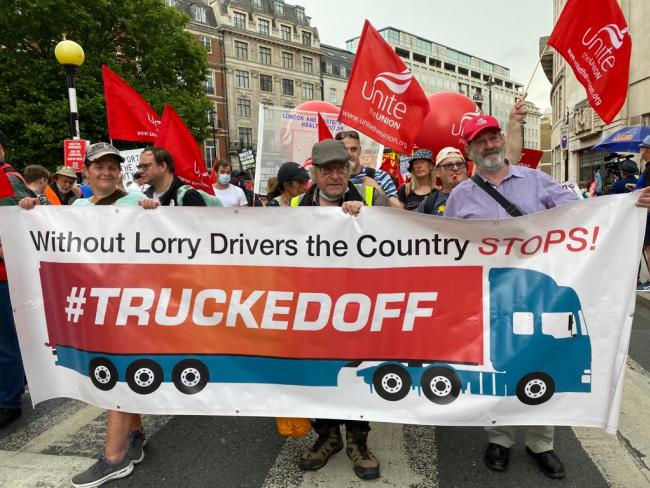
Workers run the country, but are not in power. Lorry drivers making their point on TUC march “We demand better”, London, June 2022. Photo Workers.
What would socialism mean for Britain? And what would it take to achieve it?
The ruling class loves passivity in workers – individually and in our class as a whole. Workers are attracted by passivity too. And why not? They have lives to lead and many can’t see how to change things.
But when the consequences of not acting become too great and can’t be ignored, you can’t as an individual or as a class spring into action to fix it unless you have prepared, fought and developed your capacity to resist and assert yourself.
We are told that war is inevitable, but climate change is reversible. It’s the other way round. There will always be conflict of some sort but wars are the result of human politics and decisions – which can change.
Climate change is a global, natural process. It is affected by human activity, and we can adapt to it by applying science and engineering, but reversing and controlling it is the stuff of fantasy.
Workers are not passive, even if they choose not to fight the ruling class. But when frustration and division intrude in response to problems caused by capitalism, workers can start to turn on each other instead of the ruling class – chasing illusions and ignoring past lessons and the necessity of unity.
Capitalism does not work, but the ruling class says there is no alternative; they would, wouldn’t they? Britain faces many problems: inflation; falling real wages; poverty; lack of work; absence of long-term planning; poor services; failing infrastructure; lack of investment, ineffective regulation. These are said to be “natural” and unavoidable – or at times blamed on greedy, lazy workers, or on Brexit.
'The efforts and achievements of the people of Britain should be devoted to their needs and wants. It's as simple as that...'
Can socialism work instead? The ruling class of course says not; they would, wouldn’t they? Do workers believe that too? Do they accept that “human nature” would prevent such a progressive society where ownership of the means of production is held in common and the fruits of production are for the common good?
Do they look to the demise of the Soviet Union over 30 years ago as proof that such ideas are fanciful and impractical? Or is that an excuse to confirm what they choose to believe?
Workers cooperate – in their daily lives and when exercising political or economic power. They also compete – for jobs and limited resources under capitalism. Capitalists both compete and cooperate as well. The difference is that without cooperation workers can’t make any real progress, but capitalists in the end need to eliminate their rivals (as well as exploit their employees).
Apart from nature itself, labour power – the exercise of hand and brain – is ultimately the only source of wealth. That idea is not uniquely Marxist, but capitalist economists try to avoid the consequences. As communists, we say that while we allow the ruling class to control the accumulated products of labour – in short, capital – the economic activity of the country will be devoted to the service of increasing profits, increasing capital.
While capital rules Britain, workers will pay directly by contributing their work, their labour, and paying again in many ways to prop up capitalism. Nationalisation can be positive, even necessary at times. But although it increases opportunities for planning, in a capitalist world it ends up as just another way of subsidising finance capital.
We say that instead, the efforts and achievements of the people of Britain should be devoted to their needs and wants. It’s as simple as that – but to be clear it will be immensely hard to achieve and maintain. So the sooner a conscious start is made, the more likely will be its success.
The idea of democracy that began in ancient Athens planted a seed that took centuries to grow, despite many attempts to eradicate it. Nearly 200 years ago, the emerging British working class helped to create the idea that workers can rule without capitalists. Despite changes and setbacks, this idea won’t go away.
Stop propping up rotten capitalism. It’s time to embrace the possibility of socialism and to work out what that could mean for Britain’s future.