
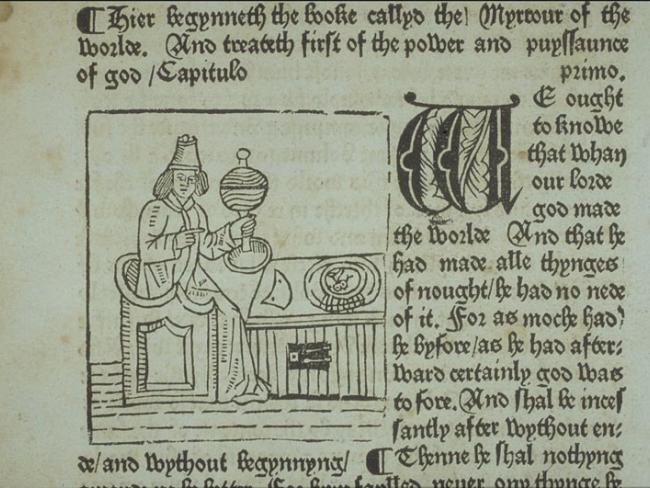
The start of chapter one of The Myrrour of the World, a popular encyclopedia translated from the French by Caxton and printed by him at Westminster around 1490. Photo Hunterian Library, University of Glasgow.
We take books for granted, but the introduction of printing led to a cultural revolution…
The 550th anniversary of the introduction of the printing press to England by William Caxton has been rightly celebrated, although rather quietly.
Printing books was a massive cultural step forward. No longer was knowledge locked away in monasteries. This spurred the development of language and literature and paved the way for increased literacy and the interchange of ideas.
A major exhibition, The English Print Revolution: Caxton and Beyond, at the University of London’s Senate House Library, displayed early printed books to show how printing transformed the country. In the words of the exhibition curator, “spreading ideas that fuelled reform, debate, contestation and discovery”.
Westminster Abbey, where Caxton’s first press stood, has arranged two talks, The English Print Revolution in September and Caxton and The Printing Press in Westminster, taking place on 19 November.
William Caxton was a wealthy wool merchant who spent much of his time in Flanders. Gutenberg had invented movable metal type round about 1450 in Mainz. Printing was invented earlier in China, but its development in Europe came about independently.
As the new printing technology spread around northern Europe, Caxton and others were quick to see its potential. While living in Bruges, Caxton had translated Le Recueil des Histoires de Troyes, a courtly romance in French, into English, and arranged for his translation to be printed there, making it the first printed book in the English language.
The Westminster press
In 1476 Caxton set up a press at Westminster within the precincts of Westminster Abbey. Westminster was the seat of government and convenient for the royal court, doubtless a consideration as Caxton hoped to gain royal patronage for his enterprise.
Caxton’s output, of which something over a hundred titles survive, shows a canny head for business. Rather than devotional works, he concentrated on the popular romances and tales in translation which he knew had been so popular with the Burgundian court. Among them were Malory’s Morte d’Arthur, The Golden Legend and Chaucer’s Canterbury Tales.
The initial market was limited to the wealthy. Caxton, with capital acquired in his time as a wool merchant, was well-placed to establish himself. Apart from the costs of the press itself, what we would now term consumables were very expensive. Paper had to be imported at the time, the first paper mill in England being established about 1490. Vellum, by contrast, was much easier to obtain, thanks to the large sheep population.
Literacy was not widespread in 15th-century England, but beginning to grow, encouraged by the development of grammar schools. London, where printing began, had higher levels of literacy than the countryside. By Shakespeare’s time, a thriving print culture had been established.
Mary I, “Bloody Mary”, gave the Worshipful Company of Stationers authority to act as a censor of the burgeoning book trade. Her brief reign (1553 to 1558) saw a period of Catholic reaction; she aimed to suppress heretical or seditious publications.
The Stationers , in conjunction with Star Chamber, continued to act as censors, though with a different emphasis, up to the English Revolution. In 1640, one of the early acts of the Long Parliament abolished Star Chamber. This opened a torrent of publications, mostly in pamphlet form, debating the course of the revolution. An attempt to reimpose censorship prompted John Milton to write Areopagitica, his closely argued defence of free speech.
Many dialect forms of English existed in Caxton’s time. He himself, in his prologue to his edition of Eneydos, a translation of the French Livre des Énéides, told the story of a merchant from the north who, landing in Kent, called on a housewife and asked her for some “egges”.
She replied that she did not speak French. A bystander said that the merchant was asked for “eyren”, the Kentish dialect word for eggs. Caxton commented, “Loo, what sholde a man in thyse dayes now wryte, egges, or eyren? Certaynly it is hard to playse every man, by-cause of dyversite and chaunge of langage”.
His decision to standardise on the vocabulary and spellings of the London Chancery English dialect established those forms as a national language, playing a part in the development of a national identity.
‘Caxton’s decision to standardise on the London Chancery English dialect established those forms as a national language…’
Caxton himself did not print the bible in English. The first manuscript translation had been made by John Wycliffe in 1382–1384, nearly a hundred years previously. William Tyndale, who declared, “I defy the Pope and all his laws: and if God spare my life, ere many years I will cause a boy that driveth the plough shall know more of the Scriptures than thou dost” printed an English New Testament on the continent that was smuggled into England.
Condemned by the Catholic authorities in the Low Countries, Tyndale was strangled and burned at the stake in 1536, reputedly saying as he died, “Lord, open the King of England’s eyes”. And months after his death Henry VIII allowed the publication of an English translation of both Old and New Testaments, largely based on Tyndale’s work, and completed by Myles Coverdale.
Once the bible could be read in the people’s language, the people could not only read it for themselves, no longer dependent on the clergy for instruction, but could also make up their own minds. A king’s claim to be anointed by God would no longer be sufficient to ensure his subjects’ obedience.