
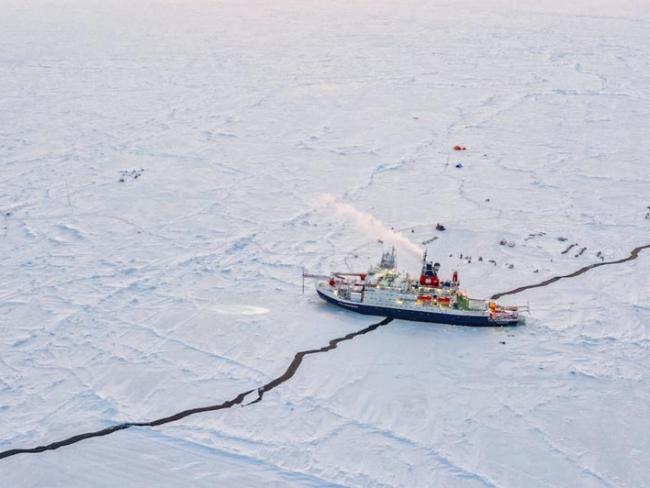
Drone image of Chinese polar vessel. Photo Manuel Ernst/UFA-Filmteam (CC BY 3.0).
In the second of a two-part feature Workers looks at the contest between the EU and the other imperial powers for the Arctic’s natural resources…
The May/June issue of Workers looked at a European Parliament report signalling the EU’s ambitions for leadership in the Arctic, and warned of Britain being dragged into war over the Arctic by the combined forces of the EU and NATO.
In this part we look at the contest between the EU and the other imperial powers – the USA, Russia and China – for the Arctic’s natural resources, and the risks of surrendering economic independence and sovereignty through unreliable partnerships with foreign powers.
For Britain, neutrality and self-reliant industrial development should be the path to economic security, peace, and working class progress.
The EU, through undermining the authority of the Arctic Council, poses a threat to unity and peace in the region. The 2025 European Parliament report to the Commission spelled out exactly why the EU aspires to be an Arctic contender.
It says, “…the Arctic’s abundant hydrocarbons, rare earth elements, fisheries and other resources are increasingly coveted.”.It means, by China and Russia. And continues, “the Arctic holds diverse energy resources crucial for the EU’s green and digital transitions.”
EU self-interest
EU self-interest wants China and Russia out of the way. A new package of sanctions aimed at slashing Russian oil revenues was passed in Brussels in April. Britain followed suit. The EU blacklist of shadow tankers was expanded to 640. UK forces seized a Russian vessel for the first time in June, shortly after defence ministers’ resignations, and challenges to the PM’s leadership. The timing is unlikely to be a coincidence.
Within its own sphere of influence, the EU continues to push a policy of keeping oil, coal and gas in the ground. Even where nations like Norway have asserted their independence, the EU pursues a strategy of ignoring national decision-making.
And, like NATO, the EU responds to indecisiveness or resistance with predatory “partnerships” – as with Greenland, Iceland, and Norway – to exert its influence right up to the Russian border. The EU calls this “peaceful cooperation”.
Norway is pushing back against EU calls to halt Arctic oil and gas development. Last year it launched the Johan Castberg oil field, its second largest and most northerly in the Barents Sea. This will produce 220,000 barrels a day for thirty years, positioning Norway as a reliable long-term supplier to Europe in place of Russia.
The rupture in relations between Canada and the USA due to threats of US annexation and tariffs has resulted in a nation-building programme. This entails strengthening Canadian energy and defence systems, building critical mineral supply chains, developing low emissions alternatives to diesel for heating and ventilating mines – and Inuit-Canadian sovereignty over the Northwest Passage.
With planning and investment, extraction and decarbonisation are not mutually exclusive. For instance Canadian universities have recently shown that a key Arctic naturally occurring, non-fossil hydrogen gas known as “white hydrogen” is escaping in significant amounts from deep below the earth’s surface in northern Ontario and elsewhere.
Crowded
The Arctic is rich in untapped minerals. It’s now a crowded and competitive field, with critical minerals at the heart of policy. In 2019 the USA signed a Memorandum of Understanding with Greenland to “jointly survey the region and exchange scientific and technical knowledge to develop rare earth and critical mineral resources”.
But the Chinese company Shenghe Resources was already there, jointly developing the Kvanefjeld Rare Earths project. This later hit snags: rare earths are often bonded with uranium, the extraction of which is prohibited by law in Greenland. The other developer is now apparently looking to a NATO-oriented partner.
Although drilling for uranium has been authorised in Alaska, the USA has been neglectful of its own mineral potential. Between 2020 and 2022 it invested around $100 billion in gigafactories for processing. Meanwhile the raw materials were piling up in China, which pursues a strategy of stockpiling and weaponising export of rare earths.
Now the USA hopes that Nordic deposits will boost its own supplies. In 2024 it signed a Critical Minerals Agreement with Norway, promising to cooperate on energy security.
Greenland is thought to contain significant deposits of indium, essential to the supply of semiconductors. This new must-have ore promises independence from China to whoever can secure that supply (and presumably from Taiwan as well, semiconductor capital of the world).
‘The Arctic is now a crowded and competitive field, with critical minerals at the heart of policy. …’
Three years ago Sweden discovered the largest deposit of rare earth metals in Europe at the Kiruna iron ore mine in the Arctic north of the country. Geological surveys estimate that Greenland may contain even more rare earths – 25 of the 34 raw materials identified as critical. This led to the EU and Greenland signing a Memorandum of Understanding in 2023.
“Nothing about us without us”, runs the Greenlanders’ slogan in defence of their autonomous right to strike their own deals. So they are undeterred in seeking ties with China.
Since 2017 the Royal Greenland Seafood company has brought in Chinese workers for fish processing. Greenland has a massive trade surplus with China – the reverse of China’s usual economic position. In 2022 Greenland exported $353 million worth of goods, with a mere $788,000 of imports.
To the imperial powers now massing in the High North, conflict in space has also now become a realistic prospect, with launch sites in Sweden and Norway. The EU wants money for space from the Starmer-led “Coalition of the Willing” – supposedly just about Ukraine’s war with Russia.
But undoubtedly the Arctic is central to Russian military thinking. Its northern coast is heavily militarised and it has a foothold on Svalbard, identified by NATO as a potential flashpoint. China also has a presence there, with a research station established in 2003.
The USA wants to open at least three new bases on Greenland and, without a trace of irony, have them designated “Sovereign Base Areas”. The arms control treaty between the USA and Russia expired in February, further augmenting the potential for conflict.
The accession of Sweden and Finland to NATO has provoked Russia into repeated probing and testing of NATO defences. A House of Lords report, titled Our Friends in the North, warned, “NATO’s enlargement will unavoidably increase Russia’s sense of vulnerability...It has heightened the role of the Arctic as an area of confrontation.”
The latest NATO initiative is the Task Force X-Arctic, led by the research ship Alliance, which set sail from Italy in June to help “maintain the fighting edge...to prevail in the High North”.
As cheerleader in chief for Ukraine, Starmer puts Britain in danger with his increasingly bellicose statements as he prepares his “big leap forward” with the EU and the next NATO summit in Ankara, Turkey, on 7-8 July. And there’s no indication that a change of prime minister would mean a change of policy towards the EU or NATO.
A security pact here, a memorandum on minerals there – the four powers circle one other, hungry for the spoils. They are no friend to the workers who fish or mine or fight for them.
Establishing friendly supply chains is essential for any nation. But caught between competition and conflict, the safest path for Britain, and our best contribution to a peaceful Arctic, is to disengage from this war dance now: stop pretending the EU is our ally or that NATO is other than an instrument of war.
Let’s invest in our own considerable natural and human resources, and rebuild our embarrassingly depleted defences to serve the needs of the British people, not imperialism.