
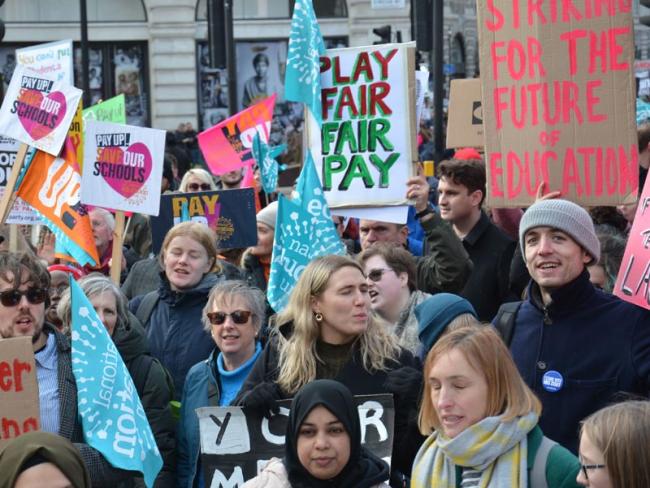
Teachers marching in London, February 2023, in their last campaign. Photo Workers.
Teachers are heading for struggle, returning to issues not settled after action in recent years…
Teachers all over Britain are steeling themselves for a fight over pay and funding. The largest teaching union in England and Wales, the National Education Union (NEU) has announced a formal ballot on industrial action after the summer holiday. That’s unless the government significantly improve its recommended pay award of 6.5 per cent spread over the next three years.
This figure represents an erosion of real pay with annual inflation at around 3 per cent. And even those pay rises will not be fully funded. Again, schools will have to cut budgets elsewhere. Existing teaching and support staff, special needs provision and buildings and equipment maintenance are likely targets.
The School Teacher Review Body has yet to publish its 2026 report with pay recommendations. If, as expected, these are in line with the government’s recommendation, redundancies and increasing workload will certainly follow.
Falling school rolls have brought redundancy and closure in primary schools. This now affects secondaries. Teachers could in response demand smaller class sizes, both improving the quality of education and reducing their excessive workload.
Ballot
The NEU’s formal ballot of teachers and support staff begins on 3 October. In the indicative ballot held earlier in the year, 96 per cent of responding teachers voted to reject the offer, with 90 per cent willing to take industrial action.
Around 55 per cent of support staff voted in their own indicative ballot, with 86 per cent prepared to take industrial action in the fight for better funding.
Education secretary Bridget Phillipson condemned the union’s decision as “wildly premature” in a BBC interview on 7 June. She said “We haven’t even gone through the pay review process. And we are investing record sums in our schools, and they have had big and generous pay awards”.
Announcing the decision to ballot, NEU general secretary Daniel Kebede, said, “The cracks in our education system are obvious to all. Schools are running on empty. Pay and workload issues are driving many out of the profession, resulting in a recruitment and retention crisis that is directly impacting on the education of our children and young people.”
The NEU is digging in for a long campaign. The government always delays pay discussions and publishes recommendations at the start of teachers’ holidays.
By announcing its decision well before the summer break, the union is preparing its members by flagging up now that it intends to ballot. That will help with planning for local and national initiatives aimed at creating a fully committed workforce.
The union describes this action as part of its campaign to save education. It invites the support of parents and all workers who desire a high quality, properly funded education system for their children.
Other teaching unions are taking a similar stand. The other main union for classroom teachers, NASUWT, agreed at its 2026 annual conference in April to ballot for national strike action if demands are not met. These include significant new investment in special needs education, a reversal of job cuts across the country, and urgent national action to tackle excessive workload.
The NAHT head teachers’ union has also backed calls for an indicative ballot on industrial action. At their annual conference in May, delegates supported a motion calling “for all steps necessary, up to and including industrial action” towards a fully funded, inflation-plus pay award.
With a range of unions representing one profession, successive governments have exploited differences to blunt the impact of any action. This present unanimity of thought bodes well for a successful campaign.