
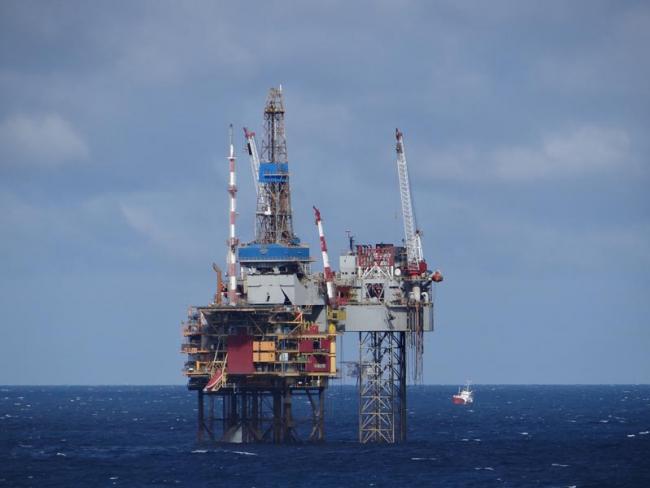
A drilling rig in the North Sea. If the government gets its way, all drilling will be banned. Photo Gary Bembridge (CC BY 2.0).
Polling shows overwhelming support in Scotland for developing our own oil and gas resources. Politicians in Holyrood and Westminster from a wide range of parties think they know better…
The resistance to net zero is constantly growing. Most people across Scotland support the development of our North Sea oil and gas, according to polling published amid mounting job losses across the north-east of Scotland.
The Scotland-wide Survation poll, conducted for True North Advisors, found 58 per cent of respondents “strongly” or “somewhat” support the development and extraction of North Sea oil and gas. Just 13 per cent oppose it, 29 per cent are undecided.
The polling also shows overwhelming support for domestic energy supply. Three quarters of the 1,003 people surveyed said we should meet as much demand as possible from our own North Sea resources rather than from imports.
Elections
The Holyrood elections will be on Thursday 7 May: energy will be a key issue. The SNP and the Scottish Greens have embraced net zero as another way to harm Britain and fracture the Union. They want our economy to suffer, on the grounds that the worse the economy performs, the better their electoral prospects.
Criticism of the Starmer government’s Energy Profits Levy is also growing. The then Chancellor, Rishi Sunak, introduced this windfall tax in 2022, when oil and gas prices were at record highs. Prices have since returned to long-term norms, but the levy remains unchanged and it is due to stay in force until March 2030.
The levy is cutting investment and adding to job losses. So our oil and gas production has fallen to record lows, leaving Britain increasingly reliant on imports.
By contrast, Norway is reopening “dead” oil and gas fields, to extract billions of pounds’ worth of fossil fuels. The fields set for reopening include parts of the Ekofisk reserve in the southern part of Norway’s North Sea sector, next to British waters.
Improvements in technology mean that closed fields that were too expensive to exploit can now be reopened. Many of our shuttered fields could yield similar riches. Our waters still hold over 15 billion barrels of extractable oil and gas, according to the latest report from the North Sea Transition Authority.
Norway’s reopening of its fields will help the country to maintain its high levels of oil and gas production for a decade or more. Its output soared to a 16-year high last year.
The Norwegian Offshore Directorate reported, “One important reason why production remains at such high levels is that the fields are producing for longer than originally planned because new and improved technology has allowed us to continuously improve our understanding of the subsurface.
“New development projects, more production wells and exploration in the surrounding area have helped extend the lifetimes of most fields...A number of fields are producing between 10 and 30 years longer than originally planned. Certain fields that are no longer producing are now being considered for reopening.”
In stark contrast, Energy Secretary Ed Miliband has since 2024 banned all new oil and gas drilling in the North Sea. About 180 of Britain’s 280 fields are set to close by 2030. The offshore sector is losing 1,000 jobs a month.
A spokesman for the Energy Department ruled out new exploration in our sector of the North Sea, saying that new oil and gas “will only accelerate the worsening climate crisis”.
Spurious
This is the usual spurious claim that if we stop producing oil and gas we will be helping to save the planet. But imports carry higher lifecycle emissions, so becoming ever more reliant on imports will only increase the emissions we are supposed to have to reduce.
And the government’s own modelling suggests that Britain will still need nearly 47 billion cubic metres (bcm) of gas a year in 2030.
‘Becoming ever more reliant on imports will only increase the emissions we are supposed to have to reduce…’
Britain’s reliance on imports is growing fast. In 2024 oil production fell by 8.9 per cent to 31 million tonnes, the lowest level since oil production was established in the 1970s. Net imports of primary oils increased by 12 per cent to 20 million tonnes.
Gas production will be down from 30 bcm to 7 bcm on current trends, while oil is set to fall from 35 million tonnes to just 13 million. This means that we could be 70 per cent dependent on imports – mainly from Norway and the USA.
The very day Miliband boasted how he’d agreed to buy £10 billion worth of Norwegian gas, Norway announced its biggest ever licensing round. We spent over £20 billion last year buying oil and gas from Norway.
Subsidies
Miliband wants us to rely on renewables. To support this policy, he is subsidising them hugely. The average household consumer energy bill for 2025 was £2,500, of which the Green Levy was £228. So much for the oft-repeated claim that green policies would cut our bills by £300.
These levies didn’t even benefit British companies. We paid billions of pounds to foreign state-owned bodies and foreign private companies, especially US private equity, giving them guaranteed income streams. Last year, we paid out a record £2.6 billion in subsidies for renewables in the Contracts for Difference scheme. 82 per cent of current and pending offshore wind capacity is foreign owned.
Britain, like any nation, cannot live without a secure energy supply. And we have exploitable resources of oil and gas.
“Just Stop Oil” is not a radical slogan but an anti-British, counter-revolutionary call. Net zero must go. The Miliband mindset must go.
Just Stop Net Zero!