
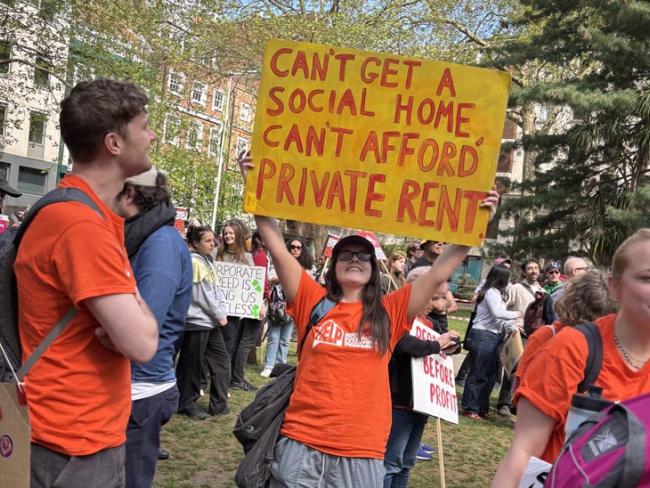
Placard at the National Housing Demonstration, London, 18 April 2026. The march began in Soho Square and ended in Berkeley Square, Mayfair, outside the offices of Blackstone. Photo Workers.
Homelessness and high rents are two linked aspects of the housing crisis for workers in Britain…
The abolition of “no fault” evictions finally became law in May after many years of campaigning. But that alone does not address the wider housing crisis, as people on a national rally and march in London on 18 April were keen to point out.
There’s much to be done: refurbish the many empty homes, and build homes that are truly affordable and where people need to be – rather than where developers can make the most profit.
Social housing underpins the rental sector. Yet its decline continues – according to the housing charity Shelter, a net loss of 170,000 in England alone over the past decade. Shelter says 90,000 new social homes are needed every year over the next ten years.
Housing problems are evident across Britain, but are most acute in London. Around one in every 45 Londoners is homeless, according to the Single Homeless Project. This includes over 210,000 people living in temporary accommodation, and around 102,000 children.
And many young Londoners are forced to live with their parents – which is also a nationwide issue. Official statistics show that around one in five of all those aged 20-34 years do so.
Priced out
In London rents are so high and housing benefits so low that thousands are priced out of secure homes. The average Londoner spends half their income on rent, leaving little for essentials. Someone becomes homeless every eight minutes.
The charity Crisis emphasises that homelessness is not only about sleeping on the streets. It includes people living in hostels, B&Bs, and unsuitable temporary accommodation, or sofa-surfing because they have nowhere else to go.
But rough sleeping has increased sharply over the past decade. London and the South East now account for nearly half of all rough sleepers in Britain – evidence of how concentrated the crisis has become. In London rough sleeping is now spreading beyond the centre and rising in outer London.
According to Evolve Housing + Support, a majority of people sleeping rough in London last year were not originally from Britain, with 139 nationalities recorded. The Chain Annual Bulletin (Greater London 2024-2025) reports that UK nationals made up 47 per cent of those seen rough sleeping, while 21 per cent were from European Economic Area countries, including Romania and Poland.
Asylum support
In March last year, a quarter of rough sleepers had come from asylum support accommodation, the vast majority of whom were illegal migrants. The Migration Observatory reported that by March this year, 58 per cent of asylum seekers in accommodation were still living in hotels in London, almost unchanged from 60 per cent in March 2023.
Statistics show that the average wait for a social home in London is 27 years, and in some areas families needing larger homes face waits of over 100 years. Those figures simply mean that social housing is impossible for many people in London.
A major cause of homelessness in England is eviction from private rented housing. Unfair evictions, soaring rents, and short-term contracts make it difficult for many people to keep their homes. Yet anyone homeless tempted to occupy empty property risks prosecution. It is a criminal offence to squat in a residential building.
Across Britain the severe shortage of social housing has wider consequences for people’s lives and health too. They are trapped in unaffordable or poor-quality housing, or stuck in temporary accommodation for months or even years.
Meanwhile, many homes remain empty for financial reasons. Some owners cannot afford repairs. Others buy properties as investments and leave them vacant—so-called “buy to leave” homes. Many more become empty after the owner dies, and remain so until there are new owners who can manage the property.
Action on Empty Homes reports that there are around 161,000 empty homes in England in 2026. Census data suggests that the real figure may be closer to 300,000. London accounts for a third of all empty council homes, with around 11,000 council properties sitting empty – many cleared for regeneration schemes that often fail to deliver new social rent housing.
Like the national government, the Mayor of London has ambitious targets for housing, but fails to meet them by a long way – even after downward revision.
Each year, more social homes are demolished or sold than built, largely due to the “Right to Buy” scheme in England which lets most eligible council tenants purchase the home they rent at a heavily discounted price.
The housing situation in London may be the most acute in the country, but the problems are everywhere. For example, Bristol is now the least affordable place for rentals – and it is widely recognised that all aspects of housing are critical in that city. The situation is similar in many other cities.
Unaffordable
Such problems shouldn’t exist in an advanced nation like Britain. As well as campaigning on the direct impacts of unaffordable and poor housing, the working class needs to address some crucial questions.
We need to ask what prevents workers from being able to afford housing?
That requires having the right to work, and high enough wages to ensure independence, rather than dependence on low benefits.
And then, how can we secure rationally allocated and decent quality social housing? This means prioritising workers already in Britain and controlling immigration.
Only by addressing these fundamental questions and challenging the shortcomings of government – national, devolved and local – can we as a nation permanently put homelessness where it belongs – in the past.