
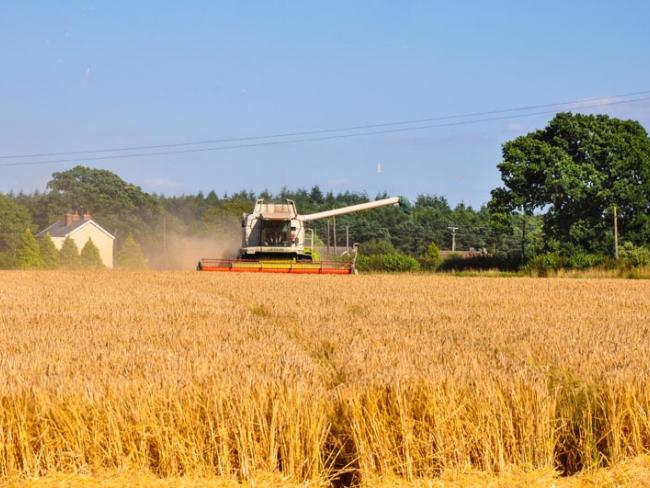
Wheat harvest, Suffolk. Despite the prophets of gloom, the world produces enough food to feed its population two times over – though hundreds of millions go hungry. Photo Martin Pettitt via Flickr (CC BY 2.0).
An Oxford University researcher looks at what people think is happening with climate change, and what actually is happening. The results are instructive…
Not the end of the world: how we can be the first generation to build a sustainable planet, by Hannah Ritchie, paperback, 352 pages, ISBN 978-1529931242, Vintage, 2024, £10.99. Kindle and eBook editions available.
Dr Hannah Ritchie is senior researcher in the Programme for Global Development at Oxford University, and Head of Research at the online publication Our World in Data.
Her work is inspired by Hans Rosling, whose fine book Factfulness, an evidence-based study of society from a historical perspective, was reviewed in Workers January/February 2022. Dr Ritchie applies the same approach to the issues of climate change.
A recent global survey found that in the UK, 72 per cent of 16- to 25-year-olds believed that the future was frightening and 51 per cent agreed that “humanity was doomed”. Ritchie’s splendid book provides data that refutes this pessimism.
By 2020, 75 per cent had access to clean safe water, up from just 60 per cent in 2000, and 90 per cent of the world had access to electricity. Although air pollution still kills 7 million people every year, according to World Health Organization estimates, death rates from it have halved since 1990.
Child mortality
In 1800, about 43 per cent of the world’s children died before reaching their fifth birthday. Today that figure is 4 per cent. The odds of one’s mother’s dying in childbirth were around 1 in 10,000. Her grandmother’s odds were 30 times higher. Since 1900 the world’s average life expectancy has risen from around 30 years to more than 70.
In 1820, just a tenth of all adults had basic reading skills, today nearly 90 per cent have.
In the 1970s, around 35 per cent of people in developing countries did not get enough calories to eat. By 2015, it was just 13 per cent. Hundreds of millions still go hungry – but we produce enough food to feed a population twice our size.
Crop yields have grown three-, four-, five-fold in the last century. “Genetic breeding…has been absolutely crucial to increasing crop yields across the world, and could play a much bigger role if we’re to develop agriculture that works well in a changing climate. Not only would it allow farmers to achieve good, stable yields, it could even mean we’d need to use fewer fertilisers and pesticides too.”
In 1990, the world produced just 20 million tonnes of seafood from fish farming, now we produce well over 100 million tonnes. We now produce more seafood from fish farming than from wild catch in the oceans.
Some fish stocks are doing well, while others are struggling. There was no clear change, and certainly no evidence of a “global collapse” of fish species, as The New York Times proclaimed in 2006.
Some who worry that the world population is too high advocate depopulation. US academic Paul R. Ehrlich argues that the optimal global population is about one billion people, down from our present 8 billion. Dr Ritchie comments, “To get anywhere close to 1, 2 or 3 billion people would mean killing billions or stopping people from having any children at all.”
“Ask a soil scientist how many harvests the world has left, and they will laugh. The concept has no scientific meaning…”
Others urge “de-growth”, the imposition of worse living standards. But, as Dr Ritchie notes, “Degrowth argues that we can redistribute the world’s wealth from the rich to the poor, giving everyone a good and high standard of living with the resources already at our disposal. But the maths doesn’t check out. The world is far too poor to give everyone a high standard of living today through redistribution alone.” We can reduce our environmental impact while becoming better off.
In 2017, the UK’s then environment secretary Michael Gove warned that the UK had only 30 harvests left. Dr Ritchie comments, “Ask a soil scientist how many harvests the world has left, and they will laugh. The concept has no scientific meaning. The world’s soils are so diverse and heterogeneous: some are degrading, some are improving, and many are stable as they are. The idea that there is a deadline by which the world’s soils will just die – apparently all at the same time – is bonkers.”
The facts
President Macron said in 2019, “The Amazon rainforest – the lungs which produce 20 per cent of our planet’s oxygen – is on fire.” One, it’s not on fire. Two, it does not produce 20 per cent of our planet’s oxygen. Dr Ritchie points out that the Amazon basin consumes almost exactly the same amount of oxygen as it produces. Since these cancel each other out, the Amazon provides almost none of the oxygen in the atmosphere.
Some 47 per cent of the world’s animal populations are increasing, 42 per cent are decreasing, and 10 per cent aren’t changing at all. 41 per cent of the world’s birds are increasing, 52 per cent are decreasing, and 7 per cent aren’t changing at all.
She concludes, “A wonderful by-product of slowing climate change, fixing our food systems, stopping deforestation, ending plastic pollution and protecting our oceans is that we stop piling pressure on the species around us.”