
31 May 2026
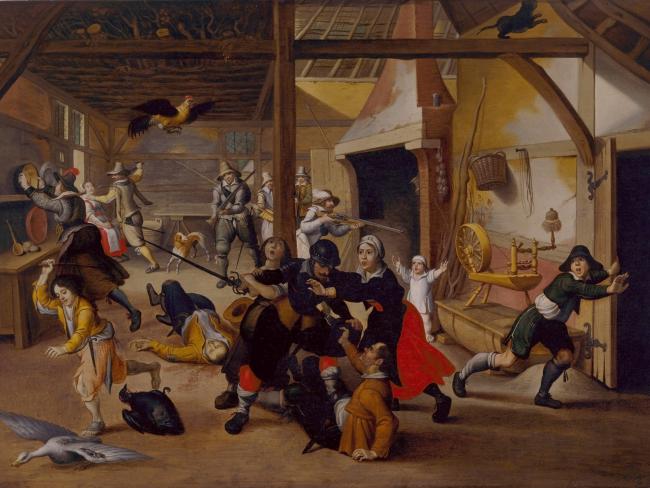
Soldiers plundering a farm (c1620), by Sebastien Vranx (1573-1647), a Flemish artist who painted many war scenes during the Thirty Years’ War. That bloody conflict had a deep and lasting impact on continental Europe. Public Domain.
The production of Mother Courage and her Children at the Globe Theatre in London is a bold and successful re-imagining of Berthold Brecht’s 1939 masterpiece.
He wrote the play in exile from his native Germany. It’s one of several plays and many poems he aimed squarely at the rising threat of fascism.
Brecht’s plays are not performed often enough. It might be said that they’re too difficult, not popular enough. It might be that as a communist, he is thought to be beyond the pale. As times get harder, he’s coming into his own.
Destructive
The play is set during the horrific series of religious and political wars in Central Europe spanning the years from 1618 to 1648. We now know it as the Thirty Years’ War – one of the most destructive conflicts in European history.
Most of the major powers in continental Europe, including the Holy Roman Empire, were involved at some point. England, Scotland and Ireland were not – being engaged in our own political conflicts, including the English Civil War. Possibly that’s the reason the Thirty Years’ War isn’t well known here.
‘Mother Courage is relevant to any time of impending war.’
Mother Courage no mere historical play, it’s relevant to any time of impending war. This production strips away the religious motivation and replaces it with a war about “territory and oil”. So we get the picture.
The leading character is a camp follower known as Courage who, with her three children, straggles along after one of the armies. They scrape a living from buying and selling, from hustling. The forces that have created the war are not present, apart from a debauched and debauching priest.
Cause
Courage herself, although unwilling, can be seen as the cause of war. She is, after all, a wannabe capitalist, doing pretty much anything short of actual prostitution to make a profit.
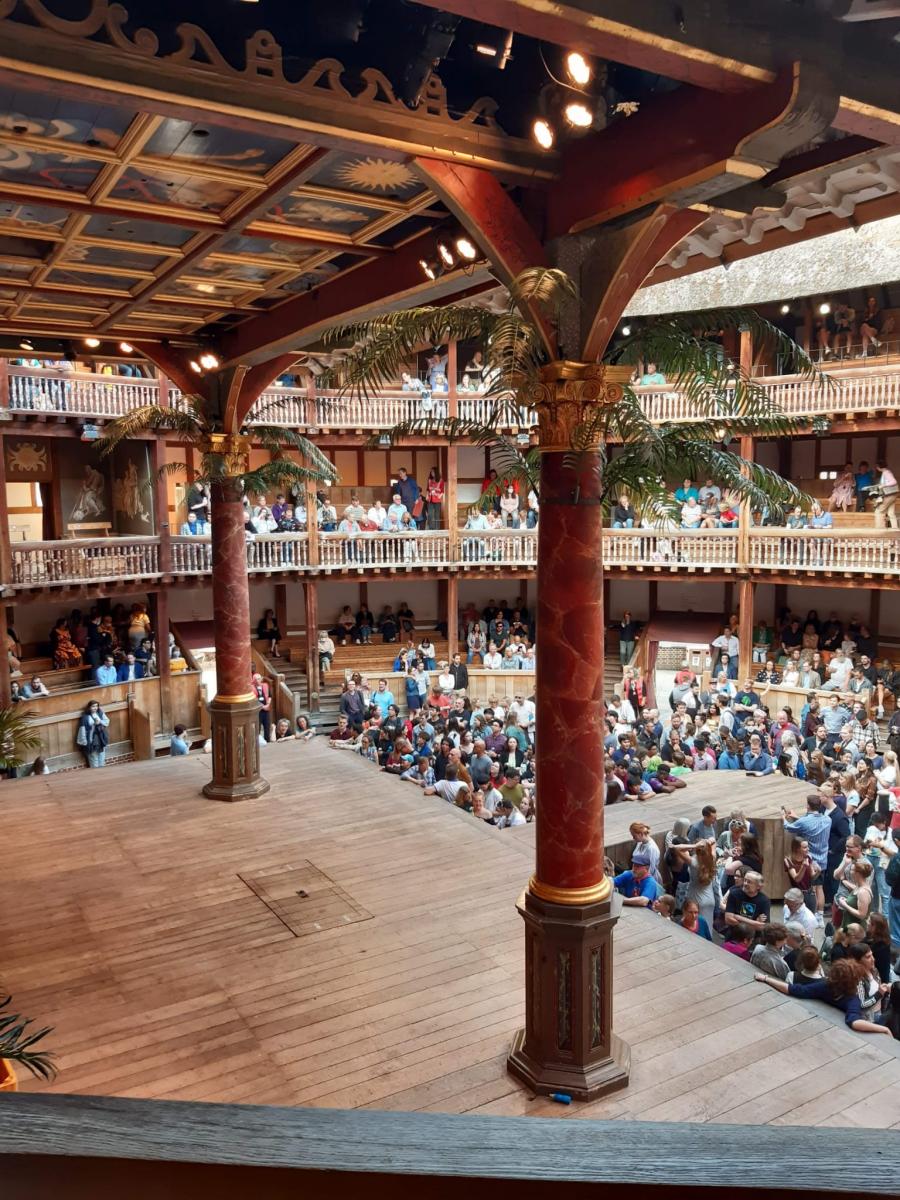
Brecht was disappointed in audience reactions to his play when first produced in Zurich in 1941. He felt they showed too much sympathy with Courage. His innovative approach to drama, called “Epic Theatre”, demanded that audiences think, not feel. Empathising with his heroine wasn’t the plan.
Interests
Instead, Brecht wanted audiences to think about how wars are fought and – crucially – how they are sustained. In particular, how they are supported by people against whose interests they are fought.
And this approach may be why Brecht’s plays are not often performed. They show us a truth we don’t want to see, that it is our toleration of, even support for capitalism that is the real cause of war.
Ordinary people
Mother Courage and her Children is said to be an anti-war play; it isn’t. It’s a play about the ordinary people whose support for war makes it happen over and over again.
The new production itself is clever, funny, and of course heart-rending. Whether it also makes the audience think as well as feel, you’d have see for yourself. But unlike much current cultural work, it does not seek to excise thought. And that’s the value of Brecht’s work.
Another play
There is another major current production of one of Brecht’s plays. The Royal Shakespeare Company, no less, have a new production of The Resistible Rise of Arturo Ui. It has just finished a well-received and successful run at Stratford-upon-Avon. A transfer to London is rumoured but not yet confirmed.
There must be something in the air to bring us two high profile productions of Brecht plays this year – it’s called war. We might even hope for a production of Brecht’s 1938 masterpiece, Fear and Misery of the Third Reich, never performed on the professional stage in Britain!
• Mother Courage and her Children runs until 27 June at Shakespeare’s Globe located on London’s South Bank.
• To learn more about Brecht and his work, it’s worth listening to a 2024 edition of In Our Time, introduced by Melvyn Bragg. Originally on BBC Radio 4, it’s available on BBC Sounds.