
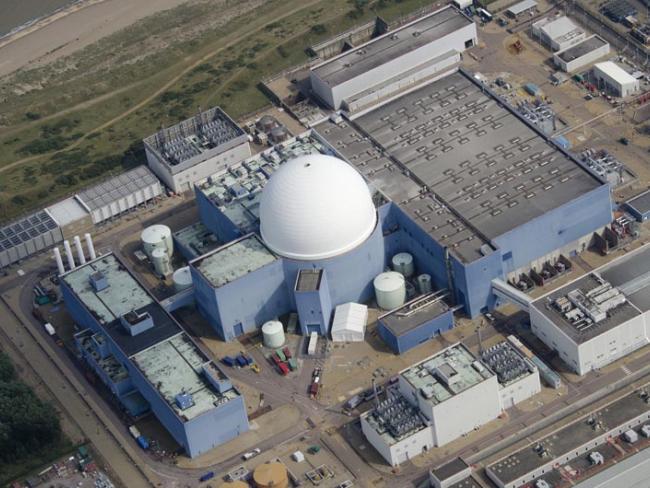
Look closely at the environmental and other costs of renewable energy technologies, and they can’t hold a candle to nuclear power…
The Poverty of Green Philosophy: A Marxist Case for Nuclear Energy in a Cooperative World, by Bill Sacks & Greg Myerson, paperback, 400 pages, ISBN 978-1637700679, Chicago: Open Universe, 2025, £21.99. Kindle edition also available.
This book makes the case for nuclear energy based on its efficiency compared with other sources of energy such as wind, solar and fossil fuels. And it sets out the problems for a globalist approach to energy.
Efficiency is measured as a ratio between energy returned and energy invested (EROI). For wind and solar this is a factor of between 2 and 4 to 1, for fossil fuels it’s 30 to 40, and for nuclear 100 to 1,000. Wind and solar power cannot possibly replace fossil fuels. Low EROI and intermittency make them the most inefficient and costly sources of energy. Nuclear power is the most efficient energy source.
A society which tried to depend on renewables alone would swiftly fail. The Greens’ low-EROI aims would doom societies to insufficient energy for a modern industrial economy, and so to real and widespread poverty.
Low EROI guarantees low productivity, low-paying, labour-intensive jobs that are insecure, tedious, and fatiguing. It prevents the development of the more interesting and skilled range of jobs characteristic of modern society. Without a high-EROI economy, the working class can never win high wages.
Building renewable generating plants and the necessary grid and storage to get the electricity produced to consumers takes huge quantities of materials, land, time, labour, and energy. These soak up world supplies and deplete resources.
Waste
Because of their relatively swift obsolescence, renewables (mainly wind and solar) produce vast amounts of non-recyclable toxic waste, dwarfing nuclear waste in bulk and dangerousness. They also incur huge maintenance and replacement costs. In all, renewables are destructive to our common environment.
Continuing to build wind and solar farms diverts huge amounts of public resources that could go into building an all-nuclear electrical system and into electrifying virtually all energy applications, except for some forms of direct heating.
A disinformation campaign funded by rival energy companies, foreign governments and NGOs promotes what the authors call “nucleophobia”. This propaganda conflates nuclear energy with nuclear weapons, distorts the truth about nuclear waste, and lies about nuclear accidents.
The authors sum up the relationship between the peaceful use of nuclear energy and nuclear weapons, “Historically, possession of nuclear reactors for electricity has never led to, and is almost never followed by, the acquisition and/or development of nuclear weapons. Of the 33 nations which have either nuclear weapons or nuclear reactors, or both, the rulers of India and Pakistan are the only two who developed nuclear weapons after, but not because, they already had nuclear electricity.”
India and Pakistan developed weapons because of their political rivalry, not their possession of nuclear reactors. Five of the remaining 31 nations – the US, UK, France, China and Russia – developed weapons first, followed by reactors for electricity. Two, Israel and North Korea, have weapons without reactors for electricity. The other 24 have reactors for electricity without weapons.
The authors point to the safe, decades-long production of clean electricity by around 440 nuclear reactors around the world. The 1986 Chernobyl accident has been the only one associated with a primarily commercial reactor that directly caused any deaths in the 82-year history of nuclear energy. It resulted from basic design flaws combined with poor supervision and training, not the way the industry runs today.
‘Renewables are not the solution. They can’t halt global warming by themselves…’
Anti-nuclear campaigners like to describe nuclear power stations as equivalent to unexploded nuclear bombs. But a bomb-like nuclear explosion cannot occur in a nuclear reactor. The authors explain “The conditions required for detonation of a fission bomb are no closer to being met in a reactor than in an ice cream parlor.”
Highly radioactive nuclear waste fission products decay away to near natural background intensity in a few centuries, not the hundreds of thousands of years claimed by anti-nuclear fear-mongers. And the more radioactive a force, the faster the rate of heating and radioactivity drops off.
After a tsunami hit Fukushima in 2011, Germany had a policy of closing its nuclear plants but this has inevitably increased greenhouse gas emissions, despite the growth of wind and solar. And in addition the policy has increased the cost of electricity to the consumer.
Blackouts
Renewables also increase the risk of blackouts. If wind plus storage alone had supplied all Germany’s electricity, there would have been a blackout or brownout (drop in the voltage of a power grid) lasting from 31 August to 22 December 2016. Any country, such as Denmark or Spain, aiming to rely on renewables is vulnerable too.
Renewables are not the solution to any problem. In particular, they can’t halt global warming by themselves. They are infeasible, unsustainable, and would lead to resource exhaustion and energy poverty.
By contrast, nuclear power is safe and practical while uranium supplies are available. Fast breeder reactors can, with repeated fuel recycling, extract almost 100 per cent of the energy in the uranium. And there’s the potential to use spent plutonium waste too, but the government wants to bury it instead.
The authors argue that a globalist approach to energy can’t succeed because it ignores the reality that the world is dominated by rival imperialisms. There can be no global solution to any problem, so long as we allow capitalism to persist.
Countries can’t rely on global approaches. Every country has to resolve its own problems, using the skills and ingenuity of its people.