
15 May 2026
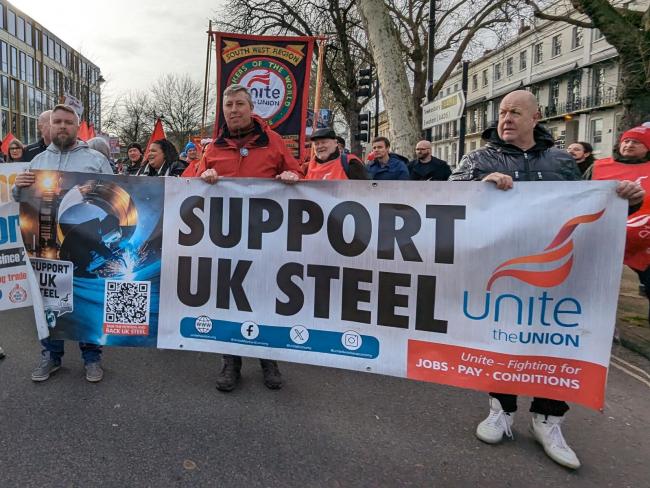
Steelworkers have long fought for the future of the steel industry. TUC march at Cheltenham 27 January 2024 on the 40th anniversary of the GCHQ union ban. Photo Workers.
On 11 May the prime minister, Keir Starmer, announced plans to nationalise British Steel. The company’s main site at Scunthorpe in Lincolnshire is the last remaining primary steel making plant in Britain.
This is the latest turn in the long drawn out saga of the decline of the British steel industry but it’s not the final answer. Even the day before the announcement, it emerged that new dry docks for the Royal Navy at Faslane on the Clyde may be fabricated abroad.
Critical
The plans are subject to a “public interest” test. This considers factors including national security, maintaining critical national infrastructure and supporting the economy.
Trade unions and the industry in general have been saying for years that steelmaking, particularly primary production, fulfils all those criteria.
If nationalisation efforts are successful, it will be the first time British Steel has been under government control since 1988. Since then Scunthorpe has been owned by four different multinational groups. The most recent is Chinese-based Jingye Steel.
Control
In April 2025 the government seized control of the Scunthorpe works from Jingye to prevent closure. It sought to sell to yet another private owner, but has failed to do so.
Even in late April this year, the government denied that nationalisation of British Steel would be included in the King’s Speech on 13 May setting out the government’s future programme.
But two days before the Speech, the Department for Business and Trade confirmed that it could not reach an acceptable agreement with Jingye. It said that the aim of nationalisation would be to safeguard UK steelmaking capacity and avoid a possible halt of production at Scunthorpe.
Options
Apparently the government will then “consider options” for British Steel. This suggests it does not think nationalisation is necessarily the long-term answer.
The Chinese government said that it will take steps to protect Jingye’s “legitimate rights” with an implied warning against full nationalisation. Early last year the Chinese company cancelled orders for raw materials, which would have closed the works.
Intervention
The government intervention in the face of that move (and after action by Scunthorpe workers) avoided the sudden and permanent closure of the blast furnaces.
That would have disrupted supply chains and risked thousands of jobs. Even so it meant buying coking coal from Australia to keep the works running.
Yet also last April, plans for a coal mine in Cumbria that could have supplied such coal in future were dropped. In July 2024, the incoming Labour government decided not to defend a court case, leading to an inevitable decision in favour of the mine’s opponents,
Unprecedented
Trade unions welcomed the latest announcement, as did local workers. In a joint statement, Community general secretary Roy Rickhuss and Unite general secretary Sharon Graham said that government action last year was unprecedented, saving steelmaking at Scunthorpe and thousands of jobs.
While supporting the “decisive step” of nationalisation, they warned that ownership of British Steel must be resolved to enable the investment needed for the plant’s future, which they believe is bright, “…with a world class highly skilled workforce making strategically important steels for the UK’s rail and infrastructure.”
“The government must ensure that all government-funded projects use UK steel.”
The unions believe that Scunthorpe has the potential to expand to supply steel for other sites in Britain. And critically they called on the government to support the industry, saying, “…[it] must also take actions to ensure that all government-funded projects use UK steel.”
Charlotte Brumpton-Childs, national secretary of the GMB Union, said it was “right the government does everything in its power to secure its long term future”. Yet Community’s response included an endorsement of the present government’s claim that the 7 May election results showed the electorate wanted a faster pace of change!
High costs
Industry body UK Steel also welcomed the move. But it said, as do some of the unions, that the government must address high electricity costs if the British steel industry is to survive.
Earlier in May the Greater Lincolnshire mayor, Andrea Jenkyns, signed up to UK Steel’s initiative to back the industry. She has committed to support the use of UK-made steel in public projects across the region.
• British Steel is not the only company in the industry under threat. Liberty Steel, a specialist steel maker based in South Yorkshire, is in administration. The government is seeking a buyer.