
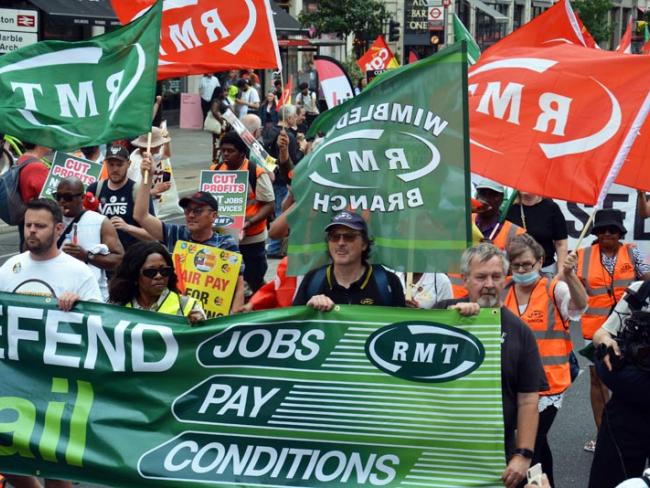
RMT workers on a TUC march, 2023. RMT policy is to use RPI in all negotiations, and to inform Head Office if an employer tries to use CPI. Photo Workers.
How to measure the rate of inflation may seem a technical, dry subject. And much of it is. But its implications matter for workers, not least because of its role as a reference point for pay bargaining…
Most pay negotiations involve arguments about the rate of inflation. Whether a pay rise meets the inflation rate determines whether it’s a real increase in terms of purchasing power or not.
Or sort of. Because the way the headline rate of inflation is calculated can significantly underestimate the real costs facing workers. And beware: the government is planning changes to the way it measures inflation.
The changes coming down the track in Britain may not have been given much publicity, but they will have consequences. And not just for pay bargaining: the government uses one particular measure of inflation, the Consumer Price Index (CPI), as a reference point for changes in pensions.
The first systematic cost-of-living index in Britain began as a monthly publication by the Board of Trade from July 1914 and was used during World War I as the basis for wage increases.
It continued to be calculated by the Ministry of Labour up until 1947, when it was developed into a new Interim Retail Prices Index. Further advances in the collection of price information then carried through to the first official Retail Prices Index (RPI) from 1956.
The rise of CPI
Some of Britain’s finest statisticians played an important role in establishing the index, which then largely remained unchallenged for half a century as Britain’s principal measure of inflation until the rise of the CPI began to assert itself.
The two rates rarely align, and the RPI tends to be higher than the CPI. The latest calculations from the Office for National Statistics (ONS) put the CPI at 2.8 per cent and the RPI at 3.1 per cent. According to Trading Economics, since 2015 the RPI has risen by around 10 percentage points more than the CPI.
‘We can thank the European Union for the Consumer Prices Index…’
And for all this, we can thank the European Union. That’s because the CPI is the British version of the Harmonised Index of Consumer Prices, developed by the European Union and adopted by it in 1997 to assess whether EU member states fulfilled the inflation convergence criterion for joining the European Monetary Union.
Significantly, the Harmonised Index, and therefore the CPI established in Britain, excluded housing costs. Why? Because the statistics couldn’t be collected from member states at the right frequency, and the data couldn’t be incorporated into a harmonised index because owner-occupation and rental percentages vary hugely from country to country.
Mirage
In other words, the idea of a harmonised EU inflation rate was a mirage. Of course, that did not deter Brussels. Nor did it deter Blair’s Labour government from following its European dream.
Rather than accept the reality that the EU’s index was totally unsuitable for Britain, the Labour government adopted it. In 2023 it established the CPI as the target rate for the Bank of England in setting interest rates, as a follow-up to one of the first acts of the government on attaining office in 1997, when it handed over control of monetary policy to the bank.
Consequently, like a cuckoo in the nest, the CPI rose from a footnote in ONS inflation reports to a dominant position, relegating the RPI to the footnote. In so doing, it dealt a massive blow to lower income groups whose housing costs typically account for far more than those of higher earners.
According to the Trust for London, housing costs of people in poverty account on average for 57 per cent of income, as against 12 per cent for those not in poverty.
The UK Statistics Authority (the UKSA, which oversees the work of the ONS) then swung its support firmly behind a version of the CPI called CPIH, which makes an adjustment for the fact that the CPI does not take account of owner occupier costs (despite the majority of dwellings in the UK being owner occupied).
And it got worse. In 2020 the then Conservative government accepted a recommendation from the UKSA to effectively abolish the RPI from 2030.
Displaying a sleight of hand even in the way the change is to be made, a measure called RPI will be retained, but the way in which it will be calculated will be entirely shifted to CPIH.
Every time the proposal to downgrade the RPI had been put out to consultation, it invariably met overwhelming opposition, but the UKSA appeared set on a course from the outset that no arguments would deflect it from erasing the measure.
Unconvincing
This was despite a marked inability to offer a convincing case to justify the dumping of the RPI. Firstly, the authority made the case on the basis of “substitution” – the concept that people switch to cheaper alternative goods and services when faced with price increases. But it was then forced to acknowledge that the effect on the RPI was uncertain because of lack of accuracy in deciding the scale of substitution.
‘The discrepancy between RPI and CPI can have a significant impact over time…’
Then the government resorted to a statistical tendency called “price bounce” – until it found that this contributed less than 0.1 per cent to the value of the RPI. And finally it has fallen back on “international best practice”, which is suspiciously similar to the argument that a lot of other countries use the CPI so we should follow suit.
The RPI tends to run about 1 per cent above the CPI – and the Office for Budgetary Responsibility (OBR) expects it do so until at least 2030. A discrepancy – the OBR calls it a “wedge” – may seem small but it can have a significant impact on the cash value of wage increases for workers, particularly over time.
Of course, there’s nothing automatic about inflation translating into pay rises. The collective strength of the workforce against the employer will always be the main driver of winning increases.
Upward pressure
But the RPI is an upward pressure on wages and for the average full time wage in 2025, 1 per cent means around £400. Multiplying that across workplaces, as well as the effect of increases year upon year, puts the total effect in perspective.
The government benefits bill is also affected as the CPI is generally linked to Universal Credit, Job Seekers Allowance, maternity benefits and the state pension. The total cost of the welfare system – 55 per cent of which is the cost of the state pension – is around £330 billion, so an extra 1 per cent in the measure of inflation would add billions to government costs.
When dealing with anyone who has specialist knowledge, such as a doctor or a mechanic, there is always a tendency to accept a diagnosis on the basis that “they must know what they’re taking about”. But there’s no economics without politics.
Workers who are unwilling to get to grips with political economics are in danger of being hoodwinked. And in the case of inflation measurement, workers are vulnerable to a statistical mugging.