
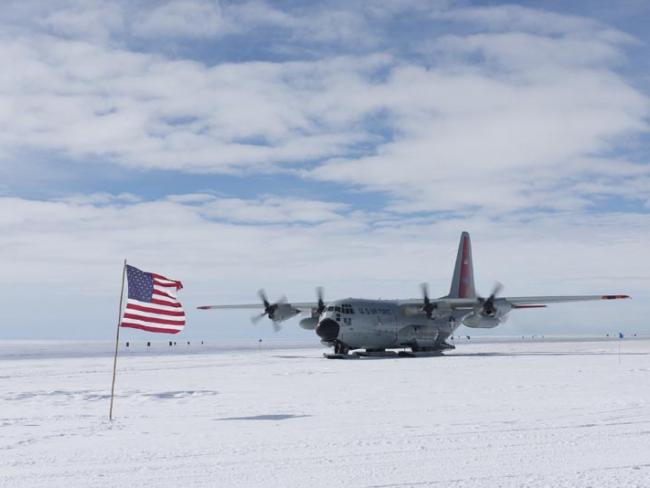
LC-130 "Skibird" from the New York Air National Guard's 109th Airlift Wing in Scotia, New York, at Camp Raven, Greenland. Photo US Air National Guard photo by Staff Sgt. Benjamin German (CC BY 2.0).
In the first of a two-part feature Workers looks at what’s going on in the Arctic, and the looming war over its natural resources…
While media attention has focussed on Trump’s threats to annex NATO allies Greenland and Canada, a European Parliament report and recommendation to the EU Commission last November shows that we should look closer to home to uncover the real threat to peace, sovereignty, industry and progress in the Arctic and its sub-Arctic nations.
The report will form the basis of an updated EU policy on the Arctic due out this summer. It amounts to an attack on the Arctic Council, the intergovernmental coordinating forum founded in 1996, building on Mikhail Gorbachev’s 1987 Murmansk speech, in which he urged the creation of an “Arctic Zone of Peace”.
Full membership of the Council comprises the eight sovereign Arctic States, those with territory north of the Arctic Circle: Canada, Denmark, Finland, Iceland, Norway, Russia, Sweden, and USA.
Apart from Russia, all full members of the Council are also NATO members (Finland and Sweden only recently); they are compelled to join NATO’s wars. But they are not all members of the EU. Further enlargement is a priority for the EU: it is exploiting the current volatile situation to encourage the re-accession of Greenland, and to acquire Iceland (which has no army) and Norway.
EU bid
The EU has long sought membership of the Council in its own right, claiming to
be “an Arctic actor with strategic interest...whereas three EU member states and two additional members of the EEA [European Economic Area] are part of the Arctic Council, while seven of its members are NATO states.” But the Council has repeatedly deferred granting the EU permanent observer status.
In 1985 Greenland exercised its autonomy to exit the EU over a fishing dispute. In 2008 a high-level conference was called in the Greenland city of Ilulissat to counter EU attempts to impose a new regime on states operating in the Central Arctic Ocean (CAO).
The resulting Ilulissat Declaration granted those states stewardship and jurisdiction over large parts of the Arctic Ocean as the ice melted. Ten years later the Council drew up the CAO Fisheries Agreement resulting in a moratorium on commercial fishing until 2037. The World Economic Forum unsuccessfully challenged its prioritisation of nature over profits.
Iceland’s fishing rights were also behind the suspension of its accession talks in 2015. A referendum in August this year will decide whether talks should resume. Control over its fisheries is at stake: as we know from our own experience, sovereignty once surrendered is hard to regain. Norway understood this well when it voted twice against full EU membership in order to protect its fishing and agriculture.
The Faroe Islands are not part of the EU. Since 1977 they have had their own fisheries agreement with Russia, craftily doubling exports to Russia after western sanctions were imposed.
The Council, based in Tromsø, cooperates on such peacetime matters as nature conservation, search and rescue, and oil spill response. It includes permanent seats for six Indigenous Peoples’ organisations. It is highly regarded for its scientific research.
Britain still retains a research station, founded in 1991, on the Norwegian archipelago of Svalbard, operated by the British Antarctic Survey. Its hydrology and marine research attract oceanographers from universities around the world.
The Conservative government’s Arctic Policy Framework of 2023 noted: “The Arctic matters to the United Kingdom...as the nearest neighbour to the region...” The British connection, both geographically and politically, goes back a long way. The islands of Shetland and Orkney were once part of Norway and still have strong connections.
The so-called Greenland-Iceland-United Kingdom gap (GIUK) is a strategic stretch of water between the north and the open Atlantic. It was used by NATO for surveillance against the USSR during the Cuban nuclear missile crisis, and is, once again, a focus of NATO attention.
In 1998 the Council admitted Britain and Poland as non-Arctic permanent observers. Five Asian countries with a fishing interest joined in 2013 – China, Japan, South Korea, India and Singapore. In its first Arctic policy in 2018, China cheekily described itself as “a near-Arctic State”. The EU was apoplectic. China was politely downgraded to “Arctic Stakeholder” – on a par with Britain.
All observers to the Council must acknowledge the sovereignty of the Arctic States, and their commitment to a low tension non-military agenda (NATO membership notwithstanding). To acknowledge the high degree of cooperation between ideologically diverse states sharing a harsh environment, the term “Arctic Exceptionalism” was coined – only to be temporarily discarded in 2014 when Russia was sanctioned in response to its actions in the Crimea.
Undermining
The Russian invasion of Ukraine in 2022 prompted further attempts to undermine the integrity of the Council, so far mostly unsuccessful. The question now is whether it can withstand the actions of Trump and his supporters.
The 2023 UK Framework stated: “The UK fully respects the sovereign rights of the eight Arctic States and Indigenous Peoples of the Region and is keen to play its part in ensuring the region remains peaceful.” Whether Starmer, with his obeisance to NATO, honours this pledge is open to question.
The EU has failed so far to persuade the Council that it should have a seat in its own right. But true to form the bloc finds ways to strengthen its control in the region: it poses as champion of the Arctic peoples, protecting them from environmental degradation as warming in the Arctic approaches four times the global average. In 2024 the EU established an office in the Greenland capital Nuuk, marking a new phase of usurpation.
The EU report belittles the Council as amateurish in the face of professional warfare, and presents the EU as the superior co-ordinating authority. It sneers at the Council’s “limited mandate”, by which it means the key principle that for the Arctic to be truly a “zone of peace”, military security should be off the agenda.
‘Seemingly less menacing than Trump, the EU is actually more expansionist, mor harmful to national economies…’
The EU’s message is clear: it is taking over from the old order, Arctic Exceptionalism is dead, peace and cooperation outdated. Compared with Trump’s rough wooing of unimpressed Greenlanders, the EU is more subtle. Seeming less menacing than Trump, it is actually more expansionist, more opportunistic, more harmful to national economies – and more completely aligned to NATO’s war aims.
In February defence secretary John Healey stated: “The UK is stepping up to protect the Arctic and High North – doubling the number of troops we have in Norway and scaling up joint exercises with NATO allies.” He was referring to the launch of NATO’s “Arctic Sentry” mission, and Britain’s key role in coordinating Nordic members’ militaries.
NATO militarisation
The European Parliament calls on the European Commission to condemn the growing militarisation of the Arctic. Yet in reality the EU, in close collaboration with NATO and Britain, is bent not just on the general militarisation of the region but on its imminent war readiness.
The question arises: what role, if any, should Britain play in the region? It matters that the Arctic should be in the right hands. But under Starmer’s supine leadership the British people are being dragged back into an ever closer alliance with NATO’s political wing, the EU, with its new bid for Arctic hegemony. Whatever Brussels decides, Starmer will go along with it.
The strategic value of Arctic locations to Britain’s defence can only be estimated once Britain is able to make independent choices free of NATO and the EU.