
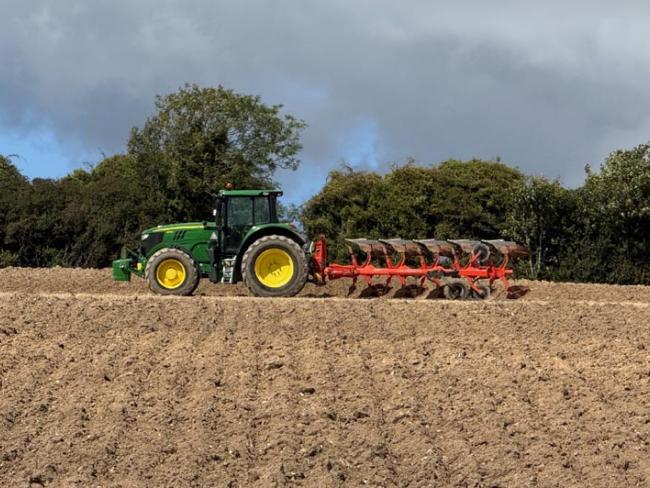
Tractor at a Sussex ploughing match. Photo Workers.
Many people would agree that Britain’s land should be used for greater self-sufficiency in food. Yet the government is doing nothing to help that, indeed quite the opposite…
Britain’s self-sufficiency in food has fallen over the past thirty years across ten of the eleven key commodities. This is clearly laid out in a report, Ready to Grow, commissioned by the National Farming Union (NFU) and published in September to coincide with Back British Farming Day.
Demand for many of those commodities has risen, due to population increases. That led to increased reliance on imported food.
The NFU described the summer of 2026 as the “toughest summer in a generation”. Drought, the rocketing costs of diesel, energy and fertiliser, and an outbreak of bluetongue disease in livestock have all contributed. The Agricultural and Horticultural Development Board report forecasts falls in beef, sheep and pig production, as well as milk production, and increases in imported meat.
Yields are likely to decline, reversing the trend since the agricultural revolution of the eighteenth century toward ever greater productivity of agricultural land.
Dispossession
Over 30 per cent of British farms are farmed by tenant farmers, leasing the land from big landowners. For the tenant farmer, the terms of tenancies mitigate against long term planning. Farmers on short-term Farm Business Tenancies, which typically last three to five years, can’t plan in the long term. And tenants face dispossession by landlords who want to take back land for more lucrative ventures, such as housing, solar projects or other “environmental” initiatives.
Farming in England is now supported, supposedly, through Environment Land Management schemes (ELMs), which replaced the EU Common Agricultural Policy’s Basic Payment Scheme (BPS). The EU scheme lived on, zombie-like, until 2023, seven years after the Brexit vote.
ELMs are supposed to pay for specific land management actions, through their Sustainable Farming Incentive (SFI), Countryside Stewardship and Landscape Recovery elements. Critics say that the schemes encourage farmers to take land out of production – as did the CAP!
The SFI in particular caused anger among farmers when online applications were closed six hours after they opened on 22 September 2026. Farmers suspect this was an underhand way to make them vie with one another for a reduced pot of money.
The Rural Payments Agency, which handles the payments, says it issued 2,500 offers from the 12,200 applications it received. It was estimated that only 10 per cent of those eligible were able to make applications.
Furious farmers pointed out that a six-hour window for applications ignored the realities of working life on a farm, and poor internet in rural areas. A previous round of applications to the scheme had also closed abruptly in 2025.
Red tape
Farmers are also frustrated at the administrative workload – having to provide geotagged photos, mapping, and input logs without which they face financial penalties.
Britain has a land area of just under 23 million hectares. About 70 per cent of that is used for agriculture, chiefly arable land for crops, and pasture and grazing land for farm animals. Towns and cities cover around 13 per cent.
An understanding of what we have and how best to exploit it to feed ourselves safely and sustainably is crucial to our national future. In May 2026 the government released a Land Use Framework for England and in August the latest version of the National Planning Policy Framework. Yet neither document meets Britain’s needs.
The framework claims that we have enough land to meet the demands of food production and housing, as well as “climate action” and nature recovery. That’s based on the assumption that productivity rises in line with historical averages. It provides for the removal of 14 per cent of land from agricultural production by 2050!
Around 9 per cent of current agricultural land will be shifted to “climate and nature outcomes”. As well as urban expansion that includes habitat creation and carbon sequestration, and more for renewable energy infrastructure, that is to say wind and solar farms.
A 25-year farming roadmap is to be published later this year. It will enforce changes in farming practices. There is a particular risk to upland farming.
Natural England (described by the Tenant Farmers Association as anti-farmer) is imposing its own ideas on stocking rates. The Commons Environment Food and Rural Affairs committee recently heard this means reducing the numbers of sheep upland farmers can graze on the fells – on the basis of no real evidence. Natural England’s ignorance of the basics of farming has become notorious.
Too many to feed
Maintaining current production levels is in doubt – and there are questions whether even that would be enough to cope with a growing population. Currently, official projections show the UK population rising to 71 million by 2034 due to immigration, peaking at 72.5 million in mid-2054.
The framework also fails to consider the international factors. Britain imports 40 per cent of its food and is to vulnerable supply disruptions due to conflicts abroad. While the exact nature of such risks is hard to predict, the current impact of wars in Ukraine and the Middle East should really cause the government to give this serious thought. Instead we have the defence minster exhorting us to hoard three days’ food!
‘Britain imports 40 per cent of its food and is vulnerable to disruptions due to conflicts abroad…’
The National Audit Office published a report, Resilience of the food supply chain to disruptions, which examined Defra’s actions to secure food supply in the face of catastrophic events such as outbreaks of animal and human disease, extreme weather, cyber-attacks, and energy disruption. It concluded that those actions have failed to ensure the supply chain is resilient to such events, not least because Defra depends on the private sector to manage food supply.
As is so often the way with devolved areas of responsibility, the Land Use Framework, and the National Planning Policy Framework apply to England alone. Might it not be more “joined up” to consider land use across Britain as a whole?
Land is popular as an investment with hedge funds, private equity and overseas wealth funds, particularly in forestry. This has increased as these investors see the potential of trading carbon credits and Biodiversity Net Gain. Major housing, commercial and infrastructure projects are required by law to deliver a minimum percentage of Biodiversity Net Gain above a predevelopment baseline, usually 10 per cent.
The government’s drive to rejoin the EU holds further threats for farmers. Already, under the 2025 Common Understanding Agreement between the UK and the EU, the parties agreed to negotiate a new Sanitary and Phytosanitary (SPS) Agreement. A report by the Andersons Centre, commissioned by the arable industry body Croplife UK, found that if such an agreement overrides British interests, then British growers could lose 10 per cent of their income and could lose out to imports from more heavily subsidised EU growers.
The report also highlighted the risk of losing the tools Britain currently uses against increased resistance to crop pests if negotiators on the SPS Agreement capitulate to the EU position.
Rejoining the EU, as well as further eroding our food security, would bring down animal welfare standards to those of the EU. It would also open the door to the return of live animal exports, after the ban imposed by the Sunak government.