
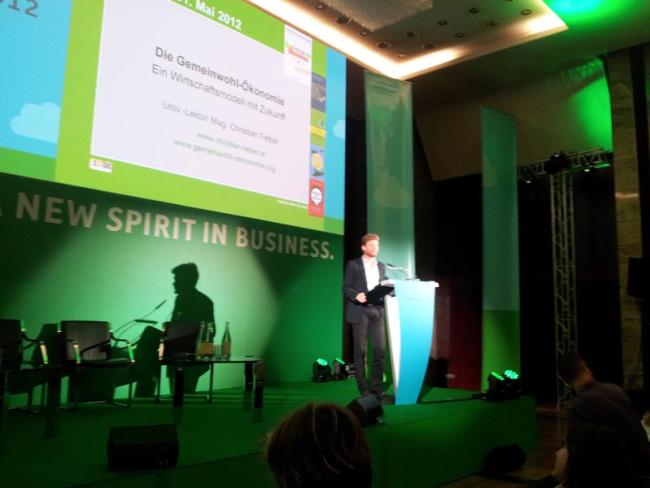
Christian Felber talking about his “Economy for the Common Good” in May 2012. Photo Nicolai Georgiev (CC BY 2.0)
There’s no shortage of alternatives to untrammelled markets – but most critics are still wedded to them…
Change Everything: Creating an Economy for the Common Good, by Christian Felber, paperback, 272 pages, ISBN 978-1-78-360472-2, Zed Books, 2015, £12.99, e-book edition available
Experience of untrammelled markets in recent decades has put capitalism in such bad odour that many people are desperately searching for other ways of organising life. Christian Felber, an economist and university lecturer in Austria, has outlined an
“alternative” to the economic chaos and enormous social suffering caused by the oligarchs of financial capital. He advocates a partnership of companies, consumers and communities based on ethical goals.
Felber begins his analysis by looking at what values should underpin an economy. He notes, “The ‘free’ market economy is based on the rules of the systematic pursuit of profit and competition. These pursuits promote egoism, greed, avarice, envy, ruthlessness and irresponsibility.” He suggests that “we thrive when we live in accordance with human values: the building of trust, honesty, esteem, respect, empathy, cooperation, mutual help and sharing.”
Under capitalism he observes that the pursuit of the largest possible amount of personal financial gain “stems from the paradoxical hope that the good of all will result from the egoistic behaviour of the individual.” Markets do not automatically transform their participants’ pursuit of self-interest into the common good.
Felber takes issue with the monetarist economist Friedrich Hayek’s claim that “Competition is in most cases the most efficient method we know.” He has found no empirical studies to back up Hayek’s claim, which has become a cornerstone of bourgeois economics.
‘Felber never refers to the power of states or the clout of entrenched market forces.’
Felber refers to academic studies across numerous disciplines that found cooperation and not competition is the most efficient method. Competition in market capitalism primarily “motivates” people through fear - of losing their job, income, status, social recognition and place in the community. Cooperation motivates people through successful relationships, recognition, esteem, mutual goals and mutual achievements.
Redefining success
The major section of the book advocates an “Economy for the Common Good” (or “ECG”), redefining economic success. Capitalism measures economic success in terms of gross domestic product, financial profit and return on investment, all “monetary” indicators. Felber argues that’s a false view “...money is not the goal of economic activity; it merely constitutes its means”.
In the ECG, improving the common good would be the highest goal. Adam Smith’s theory of an invisible hand where social benefits occur unplanned from individual economic action would be set aside. Instead society would have a method to measure and reward the success of economic activity in terms of its contribution to society.
Felder admits that an ECG requires an entirely different financial system. Capitalist banks have departed from their supposed core task of converting savings into loans and making these available to local enterprises, households and communities. “Money as credit would become a public good and the financial markets would be closed.” People would live on earned income, not on capital income.
Felber, an innocent abroad, never refers to the power of states and existing capital or the clout of entrenched market forces. All would prevent a measure of ECG challenging or displacing the current capitalist set-up. His vision is still of a market economy, not a centrally planned one. He seems to ascribe mythical power to ethical arguments holding sway.
Only a working class has the potential to effect positive changes to the economy. However, among the dubious propositions, there are lots of other stimulating ideas about how people can operate under capitalism to mitigate some of the system’s callousness. And these could have relevance to how we will function under socialism, where we will have to fashion a common economic good. ■
• A longer version of this article is on the web at www.cpbml.org.uk.