
27 October 2026
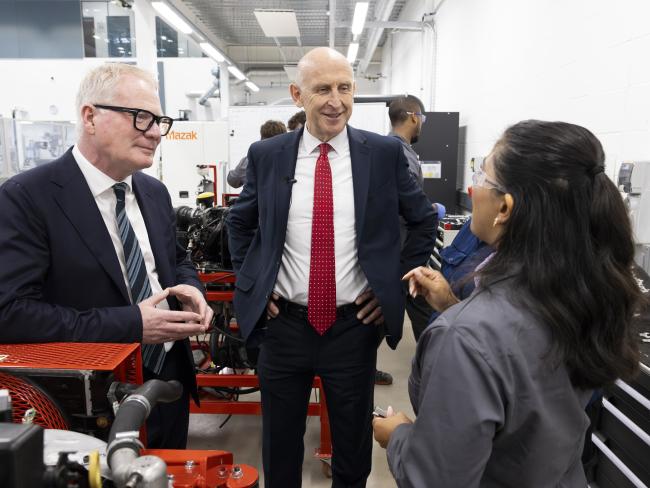
Chancellor John Healey speaks to apprentices after delivering a growth speech at the Manufacturing Technology Centre in Coventry in September. But he will have to take account of the ever-rising public debt. Photo Kirsty O’Connor/HM Treasury (CC BY-NC-ND 4.0).
One day the Chancellor has no money, the next day things are looking up. But the underlying state of Britain’s finances doesn’t change that quickly. You have to look behind the headlines to understand what’s going on…
Much has been said ahead of the Budget on 28 October about the need to spend on defence and that Britain cannot afford welfare payments at the level they have been.
The country’s finances are indeed unsustainable, though not for the reasons the government and economists tell us.
Reality has arrived after 18 years of quantitative easing. As is well known, this amounts to inflationary money printing. But it has also been used to switch commercial bank losses over to the public purse. Little of lasting value has been created.
Sleight of hand
To cover this sleight of hand we now hear government expressions such as, “fiscal discipline is the bedrock of economic stability and national security”. Every Chancellor announces a set of “iron rules” to achieve those aims.
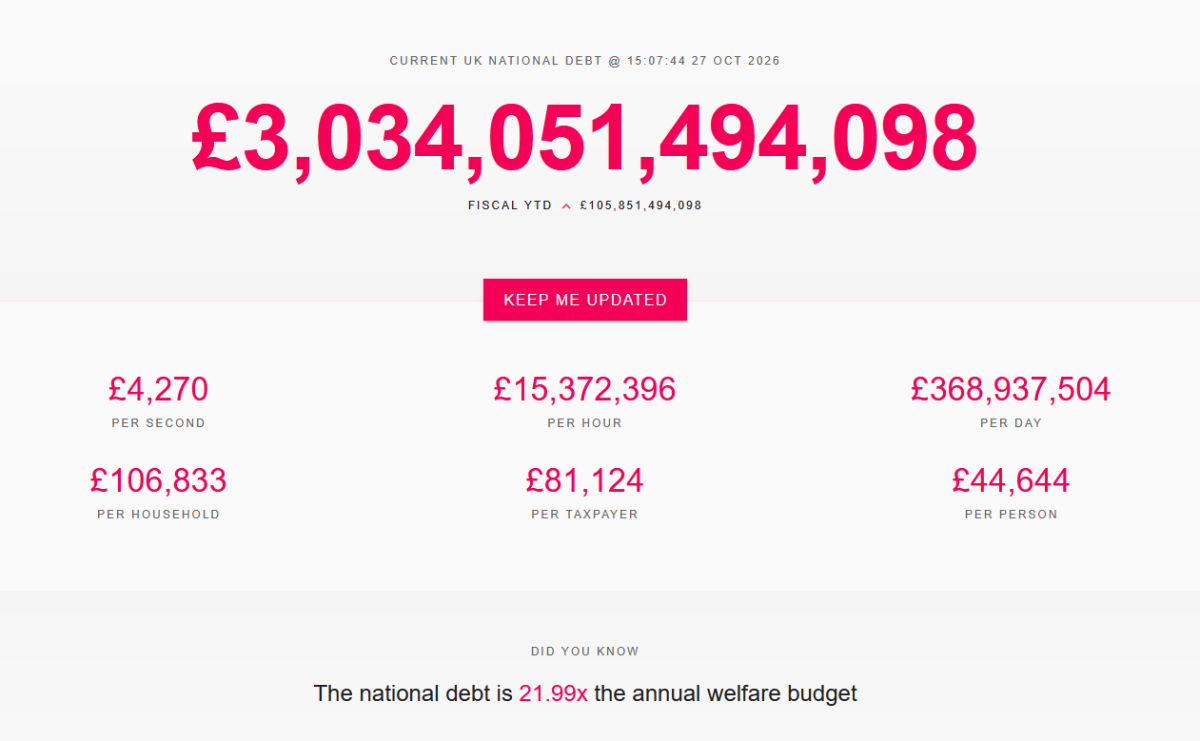
The national debt as it stood on 27 October, as estimated by debt-clock.org.
Immediately prior to 2007 the yearly cost of servicing the national debt – the interest paid – was around £29 billion. Now, the British working class are expected to pay around £120 billion and counting. The annual financial burden including bank bailouts is broadly four times greater than immediately prior to the crisis.
The underlying debt continues to rise. In September it stood at over £3 trillion for the first time, equivalent to 94 per cent of gross domestic product.
The trend is inexorably upwards – passing £1 trillion in 2010 after the financial crisis and £2 trillion in 2020 during the pandemic.
Workers have nothing to show for this – and have suffered years of low wage rises, followed by a sudden spike in inflation.
It could be tempting to say nothing has changed in Britain since 2007/2008. But this view overlooks the political change that has taken place.
Independence
Unlike 18 years ago, the main political trend is for British national independence, along with calls for an integrated British economy that has national planning at its heart. Even if we don’t yet know how to achieve that.
Unsurprisingly the ruling class, capitalists and employers, try to hinder such progress. The government, acting as its mouthpiece, has come up with the pretext that “growth” is being curtailed by central decision making.
They say that Britain’s economy can be revived through regional devolution. Apart from trying to create regional political division, these utterings have no economic foundation. More regional market competition simply tries to hide the rotten heart of destruction and division.
Regional failures
Look at the regional failures that already exist, such as regional water, regional electricity, regional gas, regional railways and so on. All are fragmented, privatised monopolies many of which are not local but foreign owned. Their capital has been sucked out, leaving them mostly indebted.
Another thread to the government “growth” story is that British reindustrialisation can be achieved through military weapons production. In other words an increase in weapons production can become Britain’s industrial policy in exchange for more taxes and cuts else-where in the economy.
Military spending
The first point to remember is that a US call for NATO countries including Britain to increase military spending was made some time back. So the British government is simply going along with an instruction from its supposed ally.
As for fiscal discipline and growth, offensive weapons built not to protect our own borders but to attack others don’t produce tangible value. Instead the resource and labour embodied in offensive weapons only produce inflation and death.
‘Behind the government talk of “keeping Britain safe” lies an inflationary dead hand: resources are used up without producing tangible domestic value…’
Quite simply behind the government expression of “keeping Britain safe” lies an inflationary dead hand: resources are used up without producing tangible domestic value.
In fact making offensive weapons is similar to saving commercial banks by money printing. Both help cause inflation but are devoid of the ability to create any use value for workers’ benefit.
On the other hand defending our borders by developing a suitable armoury for that purpose is a necessary cost that should be incurred. Defending borders is not something the British ruling class considers useful; but using offensive weapons to attack other countries many miles away they say is useful.
Illusion
British workers have realised quite quickly that Andy Burnham is wearing the same political “emperor’s new clothes” as his predecessor. And by the same measure, they have been seen as no change and an illusion, truly “he has nothing on”. So don’t look to the Budget for any encouragement.
‘The working class struggle for an independent Britain and a genuine national economic plan continues…’
The working class struggle for an independent Britain and a genuine national economic plan continues. A ten year economic plan is due to be released by this government in November. Don’t look there either.
Since 2016 previous British governments have made similar efforts. After a quick fanfare, the plan is quietly put aside.
Possibly, a ten year plan this time around is meant to sound more impressive. Well it’s not. Ten years is a very long time: the longer the period of projection, the less likely much will come of it. And if your plans are faulty in the first place, they will not improve over time. Any planner worth their salt will tell you that.
No doubt comments such as “give them a chance” will be heard again. Well no, what their planning “puff piece” will seek is distraction to avoid people looking down at their feet and seeing the rubbish they are standing in.