
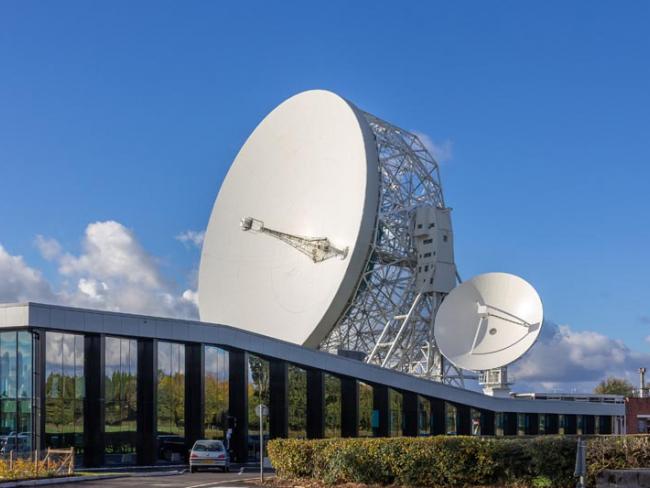
The Lowell Telescope and the smaller 42-foot telescope at Jodrell Bank, with the much newer headquarters of the Square Kilometre Array. Photo Mike Peel (www.mikepeel.net) (CC BY-SA 4.0).
Another government, another change in the way research is funded. The Burnham regime has already seen the dismantling of the Department for Science, Innovation and Technology…
Britain’s researchers will be anxiously awaiting the Burnham government’s first budget, scheduled for 28 October. It should give a glimpse of what to expect under the new regime. The signs are not encouraging.
One of Andy Burnham’s first acts when he slid into power in July was to axe the Department for Science, Innovation and Technology (DSIT) and move it back into a new Department for Business, Innovation, Science and Trade. Whether the move is positive for British science remains to be seen.
Uncertainty
What is sure is that it piles uncertainty upon uncertainty, which cannot be good for anyone involved in research. And it marks the fourth government department to be responsible for science and research in the past ten years.
The DSIT itself was formed just three years ago by Rishi Sunak’s government, to general applause from the research community. The Royal Society was delighted, noting that it had been calling for years for a dedicated department and secretary of state with a seat in the cabinet. That dedicated seat has now gone to a new minister for artificial intelligence.
The DSIT’s abolition has elicited cagey responses from researchers, mindful of where their next grant might be coming from. The current president of the Royal Society, Nobel prizewinner Paul Nurse, warned that it was “essential” that science is not a junior partner in the new department – whose prime focus is bound to be industry and trade.
Chi Onwurah, Labour chair of the House of Commons Science, Innovation and Technology Committee, has written of “concerns expressed by many in the sector” about the move, and suggested that in the autumn the committee will look into the impact of shutting the DSIT.
Onwurah also pointed out that the “machinery of government change” in July 2024 which transferred digital and artificial intelligence away from the Cabinet Office and handed them to the DSIT was already causing “operational delays” and hamstringing the implementation of new policies. Expect more operational delays from the latest tinkering.
And all the while there is the looming threat of budget cuts. Indeed, in some areas they have already started.
The UK Research and Innovation (UKRI) agency and the associated Science and Technology Facilities Council (STFC) have decided – after a “prioritisation” exercise – to remove funding for the e-MERLIN network, including the Jodrell Bank radio telescopes and other radio telescopes.
The decision has been described as “heartbreaking” and “scientifically misguided”. Funding is also being reduced at CERN as well as at various optical telescopes elsewhere such as Hawaii.
‘And all the while there is the looming threat of budget cuts…’
The STFC says, “The decision to withdraw funding from e-MERLIN at the end of its current funding agreement is the result of a comprehensive, evidence-based prioritisation process. As part of this, STFC is focusing investment on the areas that will deliver the greatest long-term scientific capability and value, including the next generation of world-leading radio astronomy facilities”.
A “comprehensive, evidence-based prioritisation” sounds like a typical glib phrase for a quick decision with little sense of real needs. Yet what exactly is meant by “the next generation of world-leading radio astronomy facilities”?
The STFC says it will continue to invest in Jodrell Bank’s future through its support for the UK’s hosting of the headquarters of the Square Kilometre Array Observatory, which it claims is already delivering significant benefits to the University of Manchester and the north-west.
But the headquarters is just that. The Square Kilometre Array Observatory operates two huge arrays in South Africa and Australia, not Britain.
Beneath all the guff about “continuing to invest”, the bald fact is that Jodrell Bank’s 76-metre Lovell telescope and others will close unless the STFC reverses its decision or alternative funding is found. In other words, British radio telescopes are to lose funding to support radio telescope arrays elsewhere.
Professor Simon Garrington, associate director of the Jodrell Bank Observatory, said that everyone at Jodrell Bank was “devastated” by the decision to withdraw funding.
“It’s not just because of the fantastic science that we do, but Jodrell Bank and its telescope network have been a national capability for nearly 70 years and a beacon for science in the north-west attracting young people into science and engineering careers,” he said.
Short-sighted
That’s no exaggeration. Around 150,000 people visit Jodrell Bank each year, including 21,000 schoolchildren. At a time when inspiring children to do science is a national priority, closing Jodrell Bank seems short-sighted, to say the least.
Overall the STFC is cutting £162 million from its budget to cope with soaring electricity costs and the rising cost of subscriptions to international organisations. Apart from the radio telescopes, big cuts have been announced for the Diamond Light Source and ISIS Neutron and Muon Source at the Daresbury Laboratory in Oxfordshire.
Speaking for the trade union Prospect, Sue Ferns said, “The cuts…are the product of a political choice. UK government investment in R&D is well behind its historic peak and also other leading scientific nations. This is forcing damaging competition between the science that’s ready to commercialise today, and that which keeps us at the experimental leading-edge of international research communities. We cannot afford to lose either.”
Indeed, radio astronomy is a classic example of how seemingly obscure basic science can lead to practical advances. Modern Wi-Fi technology was developed by Australian scientists seeking to deal with the problem that radio waves bounce off all kinds of surfaces and get broken up or distorted.
Having worked out how to clean up radio waves coming in from space, it was a short step to apply that process to lower-power radio waves, such as local Wi-Fi networks.
The political choice to withdraw funding is in line with other political choices, most notably the constant shifting of responsibility for science funding (see Box). It reflects the unwillingness of British finance capital – to which government answers – to invest in anything that isn’t likely to show a return in the current financial year.
• Related article: Constant change