
10 September 2026
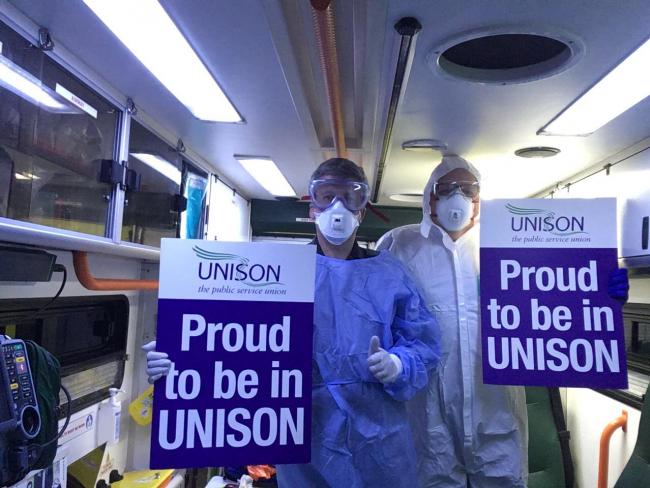
South West London, April 2020. Ambulance crews challenged management to provide adequate PPE during the Covid pandemic. NHS workers may have to take similar action in response to lack of action on working safely during heatwaves. Photo coutesy of LAS Unison.
Five heatwaves over large parts of England this summer exposed the creaking and ill-maintained infrastructure which is a daily fact of life for NHS professionals. The season may have changed, but the problems won’t go away.
Royal College of Nursing general secretary Professor Nicola Ranger said, “Swathes of the NHS and social care estate are in disrepair following decades of underinvestment and are utterly unprepared for extreme temperatures. It's becoming an impossible and inhumane place to work or receive care”. It’s hard to argue with that.
‘Wards, care homes and offices lack functioning air conditioning.’
Hospital wards, care homes and offices lack functioning air conditioning, fans, or windows that open. Nurses were collapsing on shift for want of ventilation while enveloped in PPE. Some had to be admitted as patients to the very wards where they were working.
Special measures had to be taken to protect equipment and medication from overheating: scanners and IT systems were reported as breaking down. Staff criticised management for refusing to allow adaptations in conditions or uniform.
Outdated
Patients were able to bring in hand-held fans, but outdated electrical systems prevented the use of portable aircon for staff. The RCN said that the NHS England Capital Guidance, which sets spending limits, should be updated “not in two or three years, but now”.
The government announced last year that NHS England would be shut, in itself a welcome move. But that needs legislation and reports suggest that costs are mounting. Neither is a reason to ignore or delay action on the current concerns of nurses, other NHS workers and patients.
Highest
The BBC reported in August that more than 2.4 million patients attended A&E departments in England each month for May, June, and July. These are three highest monthly recorded totals, worse than the levels expected during winter.
Ambulance call outs have increased too. Ambulance workers’ trade union Unison has warned about the negative effect on their members and patients during heatwaves.
Deaths
Statistics from the UK Health Security Agency published at the end of June estimate over 2,800 heat-associated deaths in the preceding two months, the majority in June. And that’s far worse than last year.
The new health secretary Yvette Cooper, the eleventh person to hold the post in the past 10 years, said in August that the NHS must plan for hot summer weather in the same way it does for winter – a point made by Unison weeks earlier. But the NHS struggles to cope with increasing demand in winter and the underlying issues have not been resolved.
On past experience matters can‘t be left to NHS management or politicians to sort out. Only NHS workers will be able to do so, pressuring trusts and politicians in whichever way they can.