
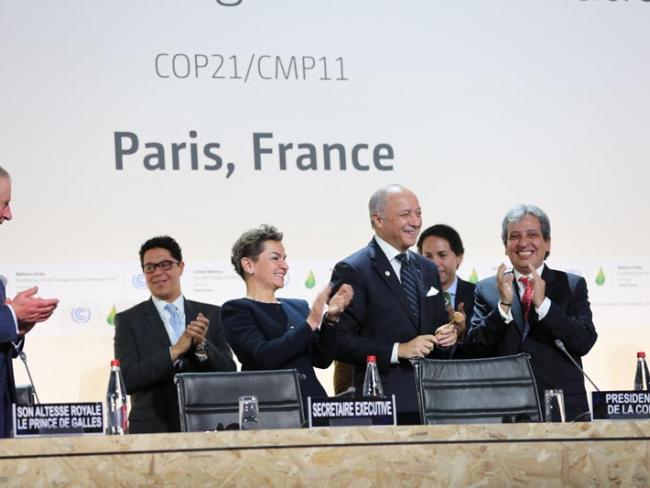
Paris climate change summit, 2015 – smug self-satisfaction was the order of the day. Now workers are paying the price. Photo Unclimatechange via Flickr (CC BY 2.0).
Can Britain move away from fossil fuels and adapt to climate change? Yes, to a degree, and these would be good aims. But government net zero policy targets won’t help…
The issue of climate change is one that – regardless of your views on the subject – now exerts a massive influence on political thinking. It has become something that we simply can’t ignore.
Obviously there are direct effects, but possibly more important is the impact on our daily lives of political decisions taken in the name of combating climate change.
Burning of fossil carbon-based fuels – coal, oil and gas – produces carbon dioxide (CO2). Along with other gases like methane and nitrous oxide, CO2 is known as a “greenhouse gas”. They trap energy in the atmosphere in a way similar to the way that a greenhouse glass traps heat.
Since preindustrial times, the atmospheric concentration of CO2 has increased by nearly 50 per cent. Over half this increase has happened since 1970. The level of methane has increased by more than 150 per cent, nitrous oxide by roughly 20 per cent.
The Intergovernmental Panel on Climate Change – the United Nations climate body – believes these increases have raised the planet’s average surface temperature by 1 ºC since the start of the industrial revolution. It forecasts this will climb to 1.5 ºC between 2030 and 2050.
In response, nearly 200 countries signed up to the 2015 Paris Agreement, which aimed to arrest the increase in CO2 in the planet’s atmosphere.
The government’s 2021 Net Zero Strategy set a target of stopping the increase in CO2 concentrations by 2050; this is what is meant by “net zero”. Why 2050? It is the point at which global warming is forecast to exceed 1.5 degrees.
Notably, and often ignored, is that reaching net zero does not mean ending all CO2 emissions. It means reducing those emissions as far as practicable, and actively removing some of them from the atmosphere, on top of those that are removed or break down naturally.
The working class is generally being kept out of the debate about climate change, instead being fed a great deal of misleading information. But workers are to be forced to sacrifice their living standards, their jobs, indeed whole industries, to deal with global warming and, of course, to maintain the profits of energy corporations.
Modern civilisation – starting at the industrial revolution – was only possible because humans harnessed energy sources and learned how to change energy from one form to another. The application of that energy underpins every aspect of our lives.
We need energy
Energy drives manufacturing and transport; it lights, heats (and cools) our homes. We need energy for the computer systems that we now depend upon – and if the use of artificial intelligence grows as predicted, the rise in energy demand will be massive.
Modern life requires that energy is readily available, reliable, and affordable. Electricity can be generated by means other than burning fossil-fuels. The simple question is what’s the best alternative?
Renewable energy sounds great, but there are practical pitfalls. Hydro-electricity generation is proven technology but hard to scale up further in Britain. Wind and solar – the major renewable contributors to electricity generation – do not produce a steady supply of electricity. Surplus power is wasted unless it can be stored.
Battery storage technology has advanced, but not yet to the extent needed for reliance on renewables. Huge amounts of energy are still needed to make batteries and later safely to dispose of them.
Nuclear fission for power generation has great potential as a clean alternative to burning fossil fuels. Prospect – a trade union representing many nuclear energy workers – calls for nuclear power to be at the heart of a secure and carbon-free energy future.
Yet the share of Britain’s electricity supplied by nuclear power is diminishing as old plants go offline. The lifespan of two existing stations, Heysham 1 and Hartlepool, has been extended by two years to 2030. Then only Sizewell B will remain – recently given a 20 year extension to 2055.
Prospect supported extending the life of existing plants, but it says that’s not enough. Hinkley Point C and Sizewell C are under construction and there are plans for small modular reactors at Wylfa. It argues for a comprehensive skills and workforce plan, and government backing for the nuclear supply chain.
Despite the growth in renewables, the gap between global electricity demand and supply has widened. Global demand almost doubled between 2000 and 2022 – met mostly by fossil fuels. The government can’t isolate the atmosphere above Britain and keep it free from CO2.
A rational energy policy requires a long-term and consistent view of the nation’s need. Instead we have short-term decisions framed against hitting net zero targets without assessing what is achievable.
Refused
The 2024 Labour government refused to support further oil and gas exploration – and so far nothing has changed with the Burnham regime. This is not a rational approach, as Unite and other unions point out; they want to keep the North Sea working. And Labour’s policy is not popular, as the recent Aberdeen by-election showed.
‘Labour is predisposed towards anything that undermines Britain’s independence…’
In Britain, workers have to confront the government and others who use net zero as a cloak to decimate manufacturing industry here. Our class should not accept sacrificing our jobs and living standards to maintain capitalism’s energy markets.
Capitalism and market forces will not bring about changes necessary to cope with climate change – to live with and adapt to it. And at present there’s no rational debate about how that can happen.
Don’t expect help from a Labour government – it is committed to both capitalism and markets and has seamlessly continued the arbitrary and short term policy of previous governments – dressed up as saving the world.
Labour is predisposed towards anything that attacks or undermines Britain’s independence and self reliance. How else can you explain the wasting of essential industries, coupled with a disregard for agricultural production?
To counter this, the working class will have to demand and insist that investments be made in research and technology aimed at reducing our reliance on fossil fuels – and to move away from economic measures that penalise long term investment.
But short-term thinking is at the core of capitalist decision-making. Planning is anathema to them. Capitalism is the obstacle to the energy security that we need. We may not be able to change the climate, but polices – and governments – can be moved.