
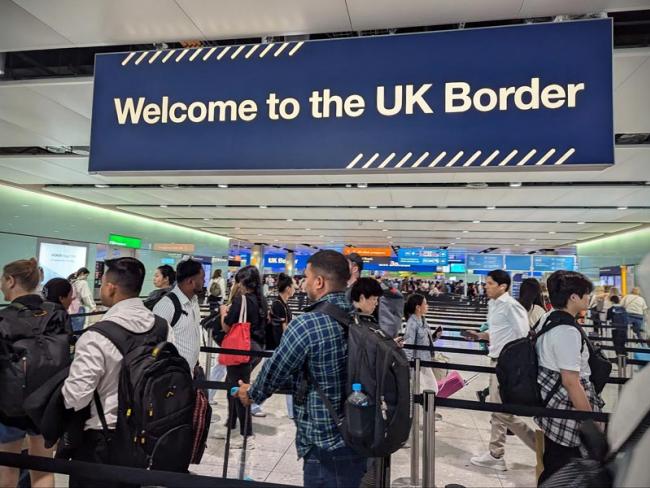
From an unequal agreement with the EU on youth mobility to low thresholds for wages in shortage occupations, governments are relentlessly encouraging more immigration to Britain. That is bad for the working class…
Immigration and its impact on Britain is the issue that will not go away. Whether it’s people arriving across the Channel or legally recruited to fill jobs that could be done by workers already here, the result is the same – undermining British workers.
Spurious justifications abound – “British workers are lazy”, “these are families escaping persecution”. No: British workers want decent pay; employers prefer to bring people from abroad and don’t want to pay for skills training. And most illegal arrivals are young men seeking work.
At heart, opposition to migration is about independence and the future for Britain. It’s not about those seeking work here, rather it’s because workers have different views from our own capitalist class about what matters for our future.
Independence is at root an attitude of mind, as we said in a 2024 CPBML political statement, “Taking Charge – Tasks To Be Done”. That may seem imprecise for a party claiming to be materialist. But it is founded on experience.
Our interests
Britain has a strong history of independence. We don’t want popes telling us what to do. Workers here have a healthy scepticism towards all religions and politicians. And we know that employers, capitalists, don’t have our interests at heart.
Despite the struggle for better wages and conditions and campaigning for social improvements, workers are still ruled and capitalists still make the decisions. Challenging that world order would be a sign of independence.
An independent attitude of mind, a tone of informed optimism is our antidote to the “learned helplessness” that the ruling class wants to generate.
Learned helplessness is a psychological state where people repeatedly faces uncontrollable stressors and eventually stop trying to change their circumstances. It leads to passivity and a deep belief that your own actions do not matter. An apt description of our political climate.
The most notable and dramatic recent manifestation of asserting independence and casting off helplessness was the vote to leave the EU a decade ago (see page 12). Yet what followed was not what many workers hoped for, especially on controlling immigration.
The strength of the Brexit vote was that it showed an understanding in the class that free movement of labour drives down wages. Which of course pro-EU politicians and timid trade unionists deny.
The weakness was that workers allowed a failure to fully implement Brexit and properly extract ourselves from the EU. What are the lessons to be learned?
In The Communist Manifesto Marx and Engels analysed the development of emerging capitalism, predicting that it would create its own gravediggers – the working class. And ruling class capitalists through instinct or understanding believe that’s the case.
How else to explain the capitalist class’s effort to unmake the working class? Look at their actions: anti trade union legislation, from the outset; unemployment; attacks on industry, with the complete eradication of some. With this, the suppression of wages, especially after
economic crises and migration as a means of achieving that.
Scale
Those elements have been present from the beginning of capitalism, but the scale and pace of the attacks has stepped up over the past two decades.
All of this disrupts community, the community of British workers. Coal miners, from the very beginning of their 1984-85 dispute, articulated that the attack was on their community as well as their industry. But above all, the ruling class uses migration as a weapon to unmake our class.
And migration frequently unmakes the countries from which migrants depart – also not a new thing. British workers, with their many connections to Ireland, should remember what forced migration did to that country from the mid-19th century on.
Earlier still, parts of Britain were subject to the same forces with the Highland Clearances. Recent statistics show net migration figures coming down, but this masks an increase in emigration combined with still high inward migration. That’s a cause for concern, not a reason for the government to pat itself on the back.
Labour’s EU reset includes an unequal agreement on the EU youth mobility scheme: expect even more traffic from the EU into Britain. But employers will be just as pleased to see young British people leave. Breaking shared generational links in the workplace and within families is another way of undermining class consciousness. It will wreck industries and communities just as much as Thatcher wrecked mining villages and towns.
‘The Brexit vote showed an understanding that free movement drives down wages…’
Free movement of labour was a big concern among workers leading up to the Leave vote. Yet what followed was a huge surge in legal migration. The result is that one in five in the workplace is foreign born, known disparagingly as the “Boriswave”. Subsequent Conservative and Labour governments followed that same path.
This is not unplanned, and it impacts the cohesion of the British working class in several different ways. Legal migration undermines jobs and opportunities. It reduces pressure on employers to train and develop workers – and does not encourage further and higher education institutes to think of Britain’s needs either.
Legal migration is further encouraged. The Shortage Occupation List, replaced by the Immigration Salary List since April 2024, includes a lower salary threshold and reduced visa application fees. And in direct contradiction to those who say wages are not undermined, the minimum salary for a specific “shortage” occupation is set at 80 per cent of the standard rate.
Legal and illegal
Legal migration far outweighs illegal migration, though that has its impact too. And it is meeting opposition (see News page 3), which is lazily described as racist scaremongering or “nimbyism”.
Andy Burnham made his position clear with the threat to spread these new arrivals to every area of the country. The government still insists on calling all these undocumented young men “asylum seekers”. It decries the inevitable criminality that feeds on illegal migration, but dare not confront it.
On 11 August the newly reinstated Angela Rayner on BBC Radio 4’s Today programme described them as “desperate, vulnerable people”, implying there were many women and children included. She ignored Nick Robinson’s inconvenient question about the communities in her care, “Do you understand, as well as sympathise with, the rage people are feeling?”
By making long term-plans and contracts for illegal arrivals, the government accepts that this is now normal. The cost is enormous and growing. It undercuts councils trying to house those on the waiting list and wrecks their housing budgets.
The Home Office outbids local authorities for accommodation. Landlords who house asylum seekers benefit from guaranteed rent agreements. Increasingly, local councils are having to house their homeless families in hotels.
And yet many trade unions and the TUC are happy to welcome anyone to Britain. Under the cloak of advocating equal rights for indigenous or migrant workers, the TUC has for many years failed to oppose the attack on British workers through mass immigration.
Such an approach conflates opposition to open borders with racism. That is a disastrous error, now compounded with raising the spectre of fascism as the likely result of controlling immigration.
This party says our defence lies in independence – an attitude of mind that learns from mistakes, sets a strategy, has innovative tactics and involves collective learning.
This means recognition that mass migration helps only capitalists and that the fight for a future begins at home, not Gaza or anywhere else. It means defending jobs, conditions and communities and not being afraid to assert these things in the face of those who would undermine them.