
7 January 2026
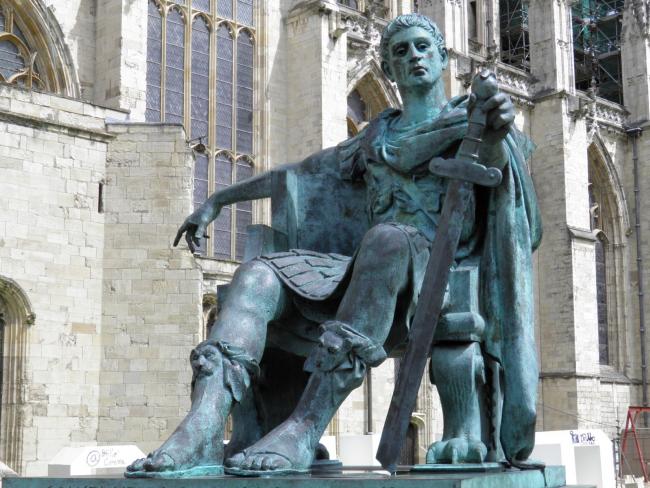
In the 4th century, Constantine the Great was the first Roman emperor to convert to Christianity. This modern statue sculpted by Philip Jackson is outside York Minster. Photo Carole Raddato via Wikimedia (CC BY-SA 2.0).
Domination, by Alice Roberts, paperback, 432 pages, ISBN 978-1398510111, Simon & Schuster, 2026. Kindle and eBook editions available.
This fine and interesting book, subtitled “The Fall of the Roman Empire and the rise of Christianity”, is just out in paperback. It’s written by well-known author and broadcaster Professor Alice Roberts, presenting a view of the interaction between politics and religion.
Roberts presents Digging for Britain, BBC TV’s flagship archaeology programme which tracks archaeological finds across Britain. With a background in biological anthropology, she is Professor of Public Engagement in Science at Birmingham University.
This latest book is a slight departure from Roberts’s previous books and programmes. It focuses on the fall of one empire and the rise of another.
Evolution
The interest lies in its analysis of the establishment of a European – and ultimately world-wide – ruling class, thought you’ll not find that phrase in the book. These rulers evolved seamlessly from the Western Roman Empire through to the universal, or (Roman) Catholic Church.
In the period of its growth, the Roman Empire used religion to help dominate the territories it colonised. As well as coopting the local people into the Roman army, it used the clever stratagem of absorbing their religions too.
Blotting out
But it had to face two monotheistic religions which would not tolerate the existence of any others – Judaism and Christianity. The latter grew directly from the former, eventually blotting out all other religions in the Roman empire.
Even though Christianity went through many schisms (as often political as theological), it became extremely useful for the empire. Especially so once the Romans began to suffer more military defeats at the hands of those the Romans called “barbarians” – Goths, Visigoths, Sueves, Alans and other Germanic and Caucasian peoples.
Business
Roberts is a prominent member of Humanists UK. She shows that anyone thinking that religion in general, or Christianity in particular, is an entirely spiritual business should think again. It is a business and always has been. And as such it is a mode of power, class power.
‘Christianity became the tool of the post-Roman ruling classes.’
The use made of Christianity by the Romans lived on after the empire in the West came to an end during the fifth century AD. Christianity became the tool of the post-Roman ruling classes throughout Europe from Bulgaria to Ireland, and then beyond into the Portuguese and Spanish empires.
And ultimately Christianity filled the same role in the British empire and those of other European colonial powers – France, the Netherlands, Belgium, Italy and Germany.
Continuity
The eastern arm of the Roman Empire lived on as a theocratic state for another thousand years. Now known as the Byzantine Empire, it claimed continuity with the early Roman Empire. Eventually, in the eleventh century, its version of Christianity broke with that of Western Europe. Couched in theological terms this was precipitated by the politics of east and west.
Byzantium eventually fell too, replaced by the rising Ottoman Empire at the end of the fifteenth century. Islam (the third monotheistic religion) filled the role of religious support for the Ottomans.
Political aims
The story of Rome is interesting and well worth reading. But it stops short of extension to the modern period. The Europe-wide church never abandoned its political aims. And it laid the foundations for the modern ruling class project of universal integration – what’s known now as the European Union, founded by the Treaty of Rome.
Constantine the Great, the emperor credited with establishing Christianity as the religion of empire, would have understood this completely. The Roman empire’s administrative areas became the Catholic church’s dioceses, which in turn became the EU’s Regional Development Areas.
Struggle
Understanding the origins of empires in Europe gives perspective to the struggle to establish and then maintain nation states in the face of imperial ambition. This struggle can be seen for the progressive and crucial step away from empire and domination that it is.
That long struggle to forge sovereignty took many forms: local monarchs breaking from Rome a thousand years ago; the earth-shattering Reformation of the sixteenth century; the national movements of the nineteenth century; right up to the potential earthquake of Britain leaving the EU. The thread of resistance to empire and to incorporation into the transnational structures of our rulers is ever present.