
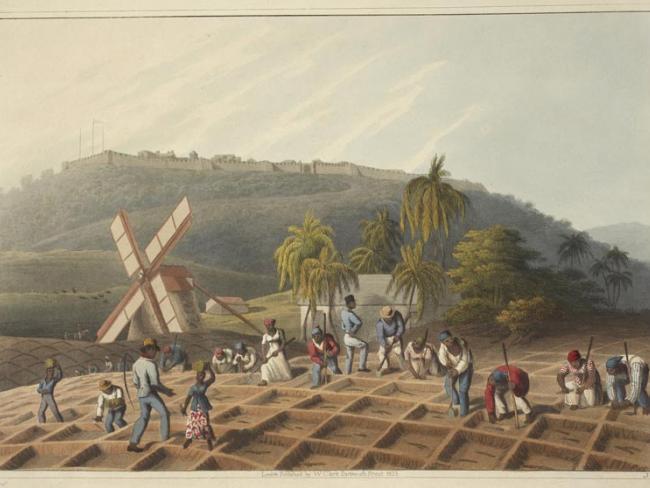
Enslaved plantation workers, Antigua, 1823. Illustration William Clark, digitised by British Library (public domain).
Revolutions are made from within countries, not imposed from without. That goes for Britain’s industrial revolution, too…
The British working class made Britain’s pioneering industrial revolution. It was not gifted from outside. In particular, their efforts were not born of profits from the Empire or from the slave trade.
The workers who built Britain’s industrial revolution never benefited directly or indirectly from slavery or the slave trade. Exploited as they were, they were the creators, the inventors, the pioneers, who created the world’s first industrial revolution.
Some refuse to accept this. Actor Lenny Henry, for example, claims that “Britain was the country that led the world in the [slave] trade.” No, Britain was not the first. Slaves had been traded from Africa for centuries before any European power did so.
Historian Justin Marozzi noted in his book Captives and Companions that the Islamic slave trade centred on North Africa and the Middle East dates back to the seventh century – and continues today. It took men, women and children overwhelmingly from sub-Saharan Africa, as well as parts of Europe and the Caucasus during the Ottoman period.
He says, “According to one study of human trafficking in North Africa, the Middle East and India, the Arab slave trade from AD650 to 1905 enslaved an estimated 17 million. It transformed societies and terrorized lives across huge tracts of the continent, especially in West, East, North and sub-Saharan Africa.”
Britain was not even the first European power to trade in slaves. Portugal was the first, and the leading Atlantic slave trader: between 1525 and 1866 it shipped 46 per cent of the total of African slave exports of 12.5 million people.
Next came the English – or, from 1707 the British – exporting 3.3 million slaves (26 per cent of the total), mostly between 1640 and 1807.
Portugal poured the wealth from this inhuman trade into building richly decorated, sumptuously ornate churches and palaces. If the slave trade somehow automatically produced an industrial revolution, why didn’t that happen in Portugal?
Historians have patiently pointed out that profits from slavery and the slave trade did not fund Britain’s industrial revolution. The capital that went into Britain’s industrial revolution came from small provincial entrepreneurs who developed local industrial enterprises based on their own capital networks.
For much of the eighteenth century, investments in industry were made almost entirely through family, social and faith networks. The only other sources of major capital financing were fellow industrialists. Historian David Richardson estimated that around 1790 profits from the slave trade probably contributed under one per cent of total domestic investment.
Finance
Finance capital was – then as now – separate from, even hostile to, industrial capital. Finance capital focused on landholding, banking and trading, including slave trading. It was finance capital that profited from slavery and the slave trade.
‘Profits from slavery and the slave trade did not fund Britain’s industrial revolution…’
The slave-owners of the West Indies argued that the slave trade contributed to British wealth. Ironically, today’s self-styled “anti-imperialists” are making the same argument. They prettify slavers by claiming that they played a progressive role of investing in industry – and denigrate industry by implying that it has rotten roots in slavery.
Lenny Henry also claims that Europeans are to blame for racism. He wrongly asserts, “The concept of race is a relatively modern construct, with its origins deeply intertwined with European colonialism and the transatlantic slave trade.”
Not so. Marozzi points out racism directed at Africans emerged very early in the Islamic world as a result of its involvement in slavery and the slave trade. Centuries later, Arabs, and afterwards Europeans and Americans would adopt it. And such attitudes were not confined to Africans either.
Criminal
Perversely, there are claims that modern illegal people-trafficking has a good effect, because Britain’s economy depends on cheap foreign labour. The claim is that this modern slavery, and mass immigration generally, provides a necessary economic boost. This wrong-headed view assigns progressive roles to criminals profiting from people-trafficking, and to those being trafficked.
But this reborn slavery is not necessary for Britain. It is a system of the grossest exploitation, a criminal enterprise from first to last. From gang masters in Africa organising and profiting from those desperate to leave their own countries, to landlords and employers who profit from exploiting the illegal labour of those sleeping twelve to a room in slums.
Those so vocal about historic injustice celebrate its modern equivalent. They claim to be extending the hand of welcome to those fleeing oppression, but in reality they are conniving at their exploitation here. In effect, they are crying, “slaves welcome here”.
According to the 2023 Brattle Report by US and Caribbean academics, Britain’s share of reparations comes in at US$26 trillion (£20 trillion), fifteen times the government’s annual budget in March 2025.
Those who are supposed to pay this are the huge majority of British people. Their ancestors barely owned the clothes they wore, far less owned slaves overseas. And our working class now includes the descendants of slaves too. How could it be just for any of them to pay trillions of pounds of reparations to governments abroad?
The British people today are the descendants of that majority of the British people who in the nineteenth century organised and supported the successful campaigns to end slavery and the slave trade. They have no obligation whatsoever to pay vast sums to the capitalist governments of those countries now freed from the bonds of empire.