
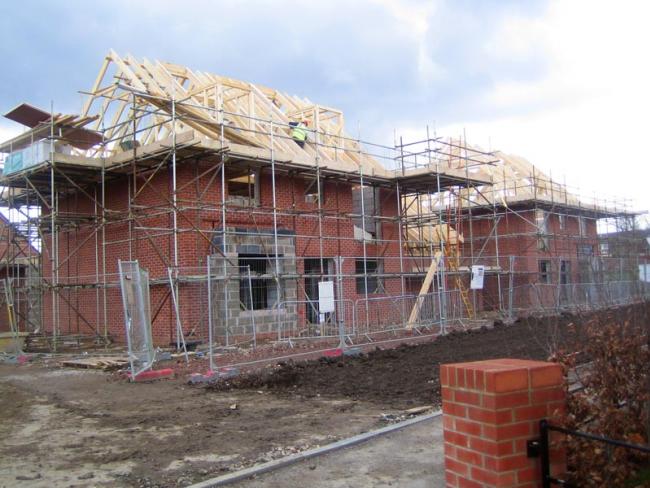
The government wants to rewrite the Town and Country Planning Act…
In March the government produced a paper entitled “Planning for the Future”. Updated on 6 August to take into account the pandemic, it is now out for consultation. It focuses on new infrastructure for towns and villages, new housing and amenities, and promises a visionary shake-up of the planning system.
Advisers include Bridget Rosewall, advocate of the City as capitalist powerhouse and expert on planning appeals; Miles Gibson, town planner, who warned of the negative effects of conversion from office space to residential; property developer Sir Stuart Lipton; Nicholas Boys-Smith, founder of Create Streets and critic of low-quality building; and Christopher Katkowski QC, who reassuringly believes that far from curtailing the powers of the local authorities and denying locals a chance to object to planning decisions, they/we have a chance to draw up “pattern books” for future standards. In other words, take control.
The government's argument about “building better, building beautiful” is seductive, and not a little romantic, with references to Georgian terraces and Victorian mansion blocks, and to Clough Williams-Ellis, designer of Portmeirion, the Italianate village in North Wales. But proposals to tear up the foundations of the planning system, the Town and Country Planning Act of 1947, are worrying.
Class
That Act has served us well. It had a class character. It transferred power to develop the land from the big landowners to local authorities, whose priority in the postwar period was provision of housing. It prevented ribbon development by introducing the Green Belt around cities. It protected the historic heritage, set up a democratic appeals process, and encouraged public scrutiny. These aspects must be preserved in law.
The burning question is this: Will control be in the hands of the people, or will it pass back to the land-bankers, the profiteers and bureaucrats?
‘Proposals to tear up the foundations of the planning system are worrying...’
The government believes the Act has become too complex through accretions over time, and favours the big investors. Sounding plausible, it wants to draw up a system based on a simpler set of rules and core standards applied nationally, but with scope for locally produced design codes. This, it claims, will give more opportunities to small and medium size developers – to become big developers! It complains that planning decisions are often overturned, without pausing to consider that success on appeal might be for good reason.
The notorious Section 106, whereby developers were supposedly bound to provide a proportion of “affordable” housing within a luxury scheme, comes in for particular criticism. It never worked anyway, but it was a measure of good intention, which will now be scrapped without replacement by something better.
As millions find themselves without a job because of Covid, with their homes repossessed, or evicted from private tenancies, a national plan for social housing is needed as never since the Second World War.
Sounding plausible again, and spurred on by the present crisis, the government promises a more democratic planning process in which young people will be motivated to participate through their “on-the-go smart phones”, digital neighbourhood groups and social networks. So away with notices attached to lamp posts! Or posted in newspapers and libraries (both under threat anyway), where ordinary folk who don't spend all their time online can see them. Is this more democratic?
“Data not documents” is the watchword. We must all learn the new language of PropTech, epitomised by the consultation itself. How is this as a sentence for people to get their heads around: “A new modular software landscape will encourage digital innovation and will consume and provide access to underlying data”?
We must not be too cynical. The consultation suggests some important measures – gentle densification around high streets, upskilling of planning departments, jobs growth in construction.
But let’s not forget the simple demand for people who are not wealthy to have somewhere to live.