
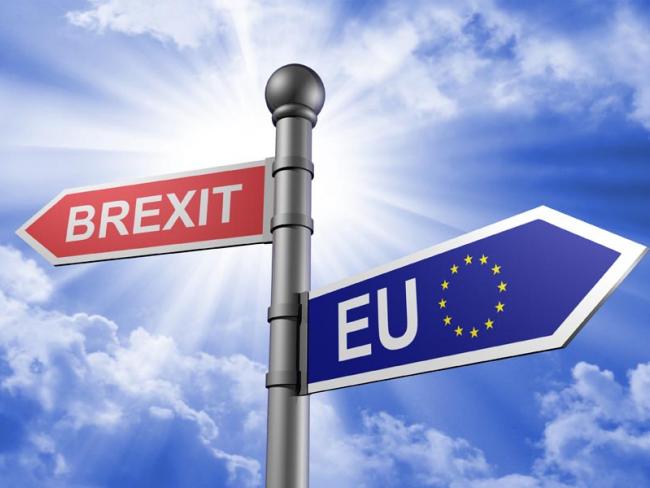
Did Brexit really happen? Yes. But not the full independence people voted for. Image Alterov/shutterstock.com.
A decade after the epic vote to leave the European Union, the fight for independence continues - in the face of continuing attempts by government and the establishment to ignore or overturn the referendum...
It’s now ten years since the Brexit vote. It was poetic justice that Starmer resigned on the tenth anniversary, almost to the day, of the democratic vote that he did all he could to overturn.
On becoming prime minister he wasted no time in meeting the president of the EU Commission to achieve his aim of rejoining the EU under the guise of “closer relations” with the EU.
The next EU-UK summit was due to take place in July, now postponed until October or November. Nothing in these talks is ever put to the British people for their approval.
Who supported the Brexit vote? We’re told it was the “left-behind”, those nostalgic for empire, the less educated, Northerners and so on. But never the truth – that it was the majority of the working class.
Some who still oppose Britain’s independence now lump Brexit in with what they like to call far-right populism and with support for President Trump. They paint voting to leave the EU as intrinsically right-wing, by which they mean backward – along with all the arguments about sovereignty and democracy and the right to national self-determination. This mindset displays complete contempt for the British working class.
Fascism
Similarly, terms like right wing and fascism are bandied about, attempting to discredit those who voted Leave. When it comes to fascism, we should not forget that the self-proclaimed fascist Oswald Mosley, the founder and leader of the British Union of Fascists, was one of the first British politicians to speak up in favour of a United States of Europe.
Detractors of Brexit often reduce Leave voters’ motives to emotions – anger, hate, fear, and resentment – rather then a rational choice. Or else they diagnose Brexit as an act of collective pathology. Days after the vote psychotherapist Philippa Perry suggested in the Guardian that Europe would not even have been the issue, “If we had…listened to fears, found a way of framing them, and taken action to include people who feel like an older child being pushed aside.”
Her husband, the artist Grayson Perry, explained to the Political Science Association’s 2016 conference that “the liberal academic elite…let us down because they are not emotionally literate enough to understand what 52 per cent of the electorate was thinking – or feeling, should I say…” That tune has not changed in the 10 years since.
Did Brexit achieve anything? One recent book points to 75 Brexit benefits:tangible benefits from Britain having left the European Union, by Gully Foyle (a pseudonym), including animal welfare protections, ending our annual donations to the EU (£14 billion in 2020), deciding our own farming, fishing and environmental policies – and the cheapest bananas in Europe.
From 2016 to 2026, the UK GDP is up by 57 per cent – more than Germany, France or Italy. Britain’s total exports have risen from £583 billion in 2016 to £947 billion in the 12 months to May 2026, a rise of 62 per cent, again ahead of Germany, France and Italy. So clearly being in the EU doesn’t automatically produce greater growth.
‘Who supported the Brexit vote? The majority of the working class…’
There was one previous referendum after which Britain’s economic performance did get worse: GDP per head fell, the share of world trade fell, productivity and investment were weaker, and the balance of payments got worse. But that was after the 1975 referendum which endorsed our joining the EEC in 1973.
Britain has continued significant trade with Europe under the 2020 EU-UK Trade and Cooperation Agreement, negotiated without tariffs or quotas – higher levels of trade than when Britain was in the EU.
The promise on the bus
Most of us remember the famous referendum promise on the bus – £350 million a week to the NHS. But we don’t all remember that this promise was actually kept. The NHS got the £350 million a week – and more.
The NHS budget rose in real terms (at 2022-23 prices) from £144 billion in 2016-17 to £182 billion in 2022-23. That is an extra £723 million a week – more than twice the promised extra £350 million a week.
The then prime minster, Theresa May, kept this quiet. Why? Because she knew that if she publicised this extra money for the NHS, she would be publicising the fact that the Leave campaign had not lied about the extra investment in the NHS. She would be telling everybody that the Leave campaign’s promise had been carried out.
The reason Britain’s economy has not grown more is not down to Brexit. One key reason is that energy prices are very high, which is bad not just for households but for all our industries. Why are they so high? Because Green policies result directly in higher energy prices. The countries with the cheapest electricity are those which have high shares of that reliable trio: gas, coal and nuclear.
May, Johnson and Starmer all implemented the EU policy of net zero. The European Climate Law of 30 June 2021 imposed net zero on all EU member states. They did not have to do this, because we are not in the EU. The Theresa May government chose to do it.
On 24 June 2019, the government increased the 2008 Climate Change Act’s 2050 decarbonisation target from an 80 per cent reduction in greenhouse gas emissions, against 1990 levels, to a 100 per cent reduction. It did so with a statutory instrument, which reduces parliamentary scrutiny. They did not need to worry – the only response from Labour was that they thought of it first!
Migration
Most people assumed that net migration would fall after Brexit. It didn’t. That is not a failing of Brexit. Successive governments wanted to increase the supply of labour to keep wages down. They wanted to undermine trade union pressure to invest in training the skilled workers that Britain really needs, and investing in the apprenticeships that Britain’s young people really need.
As prime minster, Boris Johnson implemented the EU policy of mass immigration by opening the door to 3.9 million immigrants. Again it was not necessary and against Britain’s interests – that is to say, the interests of British workers.
The number of non-EU workers under 25 employed here is more than three-and-a-half times greater than it was in 2020. The number of British workers under 25 has risen by a minuscule amount over that time – by just 0.5 per cent.
If we had a referendum on controlling migration or on dumping net zero, workers would win. But the ruling class would thwart those votes, as it did Brexit.
But we must ask why many did vote to stay in the undemocratic, austerity-enforcing EU? Some may have voted not on the issue, but against the Leave campaign, its claims and its leaders. They missed the point. The referendum was not about the merits – or otherwise – of the campaign but on the matter of sovereignty.
‘Ten years on the British people still believe that decisions about Britain should be made in Britain…’
Independence from the EU should have meant that Britain controlled its borders and defended its waters. Our 2016 vote was a vote for self-reliance, our democratic assertion that decisions about Britain should be made in Britain, not in Brussels, not in Washington. Our vote against the EU was also a vote against its accomplice, NATO.
The EU boasts that it is a force for peace. Its supporters claim it has saved Europe from wars. But examination of the EU’s intimate relationship with the aggressive NATO alliance exposes that view as idealist fantasy. A key change came when NATO, at its Strasbourg summit of 4 April 2009, committed itself “to improve the NATO-EU strategic partnership”.
EU members in total spend more on the military than Russia, more than China. For two years Starmer told us that the way to avoid war is to prepare for war. But preparing for war is necessary if you want to wage war.
People want independence
The ruling class tells us that we have now rejected Brexit, rejected independence. A YouGov poll last year showed a different picture. It asked people if they preferred 20 policy areas to be decided at national level or supranational level. The most popular answer for all 20 policy areas was – “UK government alone”. Preference for national responsibility for policymaking spanned the Brexit divide.
Many EU policies are not in Britain’s interests. But, whatever we think our decisions should be, the British people voted in 2016 that decisions about Britain should be made in Britain. Ten years on British people still believe that decisions about Britain should be made in Britain.
Did Brexit really happen? Well yes – we took a necessary, indispensable step forward. But we did not achieve the full independence that we voted for. Ten years on, we must accept that the key polices of net zero and open borders will not end until the working class, the vast majority of the country, takes responsibility for running Britain.
Independence is a necessary condition for progress. So is national unity, but that’s another topic.
The British people want independence and industry and borders, but we still allow the ruling class to have a veto on our progress in all these matters. The ruling class is the sole obstacle to getting what we need and want. For independence, industry, borders, our class needs to remove that ruling class from power.
Without revolution, we will never have independence. Without revolution, we will never be able to rebuild Britain on an industrial base.
• Related article: What has the EU ever done for us?