
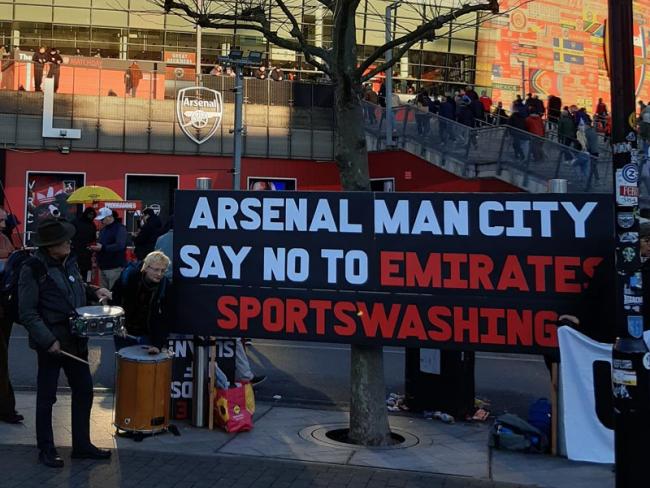
Stall outside the Emirates Stadium before start of Arsenal’s clash with Manchester City in February 2025. The result was a big win for the Gunners – but is it all really about money now? Photo Workers.
Like a bad smell, capitalism gets everywhere if it’s not stopped. In this two-part feature we examine its impact on sport. We start with football, worldwide…
In Britain, football as a game was banned many times by royal decree. As long ago as the fourteenth century our rulers worried about its propensity to bring people together, potentially violently. Our modern game, though, is entirely a product of the industrial revolution.
Football was ever an antidote to work: an escape, something to be enjoyed. But its simplicity is reflected in its resistance to change. For all the talk of recent innovations the basic structure of football remains the same: eleven players, 90 minutes, very few rules.
And football is international. Kicking games are recorded in China over 2,000 years ago, Ancient Greece, the Roman Empire, Japan, Mexico and Central America and elsewhere. But Britain’s role in developing football parallels its role in the industrial revolution.
Just as Britain became the industrial workshop of the world, modelling its factory system and proletariat for others to follow, so it was British workers abroad who spread “the beautiful game” (a phrase popularised by perhaps its greatest exponent, Pele).
Professionalism among players was a direct product of industrialisation. Workers who were good enough had to be released from their workplaces – factories, mills, mines – to be able to travel, train and play.
The burgeoning railway network made competitive games possible, evolving into regular leagues. Perhaps most importantly, it enabled large numbers of working class men to travel to support their local team.
Big enough to exploit
Gradually of course the bad smell of capitalism crept in. Clubs became big enough to be owned, and crowds became big enough to be exploited. The ubiquitous gambling and advertising began to appear between the world wars.
But owners rarely spent money on facilities for fans. It was this attitude that led to horrendous, and entirely preventable mass deaths and injuries in terrible circumstances. Most notably at Ibrox Park, Glasgow in 1971 where 66 people died and at Valley Parade, Bradford in 1985 where 56 people died.
Like so much else, it was during the 1970s when things changed. Clips of the 1970 World Cup in Mexico show little advertising in stadiums but by the 1974 Cup in West Germany it was everywhere.
‘Like so much else, it was in the 1970s when things changed…’
That decade also saw the arrival of a lumpen element attending games whose violence and general mindlessness drove away those few families and women who had braved the grounds. Minor explosions of violence marred most weekends and mirrored the erosion of class consciousness that blighted the next decade with its embrace of Thatcher.
Eventually the deaths of 39 Juventus fans in Brussels, which led to the banning of English teams from European competition in 1985, and the police-assisted slaughter of 97 Liverpool fans at Hillsborough in 1989 meant that if the British, more specifically the English, wanted their football they would have to change it.
And change it they did. But in doing so they created an opportunity, one that capitalism seized with both hands.
Civilising the game and particularly introducing all-seater stadiums led to claims that the game had been gentrified. What these criticisms missed was the grab that capitalists made for the game. In 1992 the top English clubs broke away from the Football League and set up on their own.
The Premier League is a separate, elite competition based on television revenues. It soon led to foreign ownership of clubs: as a model it has proved eminently exportable. There is now a Primera Liga in Spain, League Un in France, Eredivisie in the Netherlands, all based on the Premier League.
And this profit-extracting model has even been adopted by other sports such as tennis, snooker and darts. But it is in football that the most developed forms of capitalism can be seen.
A game of four quarters?
In the 1994 World Cup in the USA, the authorities tried to change the age-old rule that games have two halves, substituting them with four quarters so they could have more television advertising.
At this year’s World Cup, again in the USA, the authorities and advertisers finally got their way. Games were effectively divided into four quarters: the advertising breaks in each half were called “hydration breaks”. All said to guard player safety…even in games played in cool temperatures. Few fans were fooled.
And then there’s Manchester City. Or rather the Abu Dhabi Group, as they perhaps should be known. Clubs are now owned by despotic feudal sheiks who run them like the autocratic dictators they are in their own countries.
Manchester City’s owner is of the type who makes the laws – holding high office in the United Arab Emirates. This view is what is being tested in the Premier League’s case about breaches of its financial rules. Who runs football? Who makes the laws of the sport? Does Manchester City have to abide by Premier League rules?
Some people may think that all club owners are as bad as each other, they’re all capitalists. But all capitalists are not the same. In fact some of them are barely capitalists, being more feudal than bourgeois.
Contempt
The contempt with which City’s owners have treated the process in which they are now ensnared is breath-taking. This should lift the veil on how those countries in the Gulf – all allies of the British ruling class – are run.
Breaking rules for them is not an issue: they’re accustomed to making the rules in the first place. And in truth the problem is not about the club’s finances – its actions only become cheating when others abide by the rules.
The overwhelming issue is whether British workers accommodate this, and in so doing become subservient.
City fans with banners saying “in Khaldoon [the UAE-appointed Club Chairman] we trust” proclaim that they believe the foreign feudal owners rather than the English Premier League, who have found the owners guilty of breaking the financial rules.
More lickspittle still is the view of the British prime minister. He said, among other things, that there should be “no rush to judgement” – typically he tried to draw back a few days later after criticism.
The complaint of everyone except those keen to sportswash Manchester City is that it’s taken far too long, not that it’s been a rush job! The sport’s European governing body UEFA began looking into the club’s finances as far back as 2009.
The Premier League’s investigation began in December 2018 after media exposures. Also in 2018 HMRC opened a probe into the club’s tax affairs; it does not seem to be in a hurry either judging by its response to recent questions from the parliamentary Treasury Committee.
In this sense, football is a microcosm of the society in which it operates. Allowing British capitalists free rein to exploit is bad enough. Kowtowing to a state many aspects of whose legal system are based on Sharia, is reprehensible.
The problem with a bad smell though is that you can’t keep going round closing windows to keep it out. At some point you have to remove the source of the stench.
In the next issue we consider the impact of capitalism on the county-based game of cricket. Unlike football, it is almost completely flexible as a game – and indeed, as we shall see, is being flexed to within an inch of its life.