
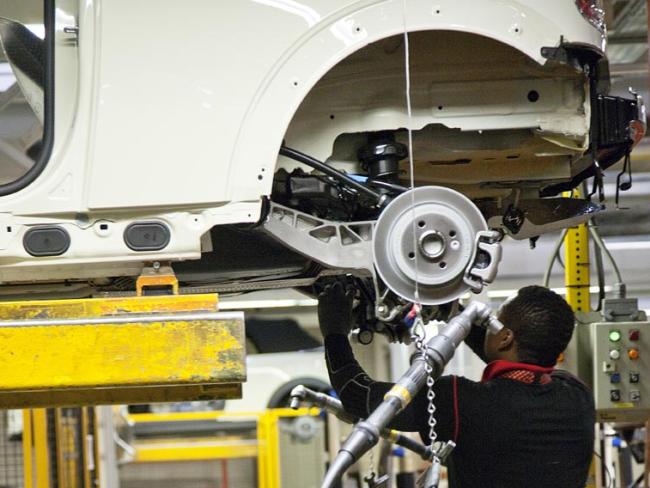
Manufacturing the Mini, Oxford. Photo Department for Business, Innovation and Skills, via Flickr (CC BY-ND 2.0).
There is a growing realisation that increasing dependency on imports of manufactured goods, food and energy presents many risks…
It has become commonplace to say that British industry needs to be rebuilt or revitalised.
Not only is the British economy more exposed to shortages and price increases than it ought to be, but important skills and jobs are lost. Even Labour minsters have jumped on the bandwagon and have said we must reindustrialise. What they mean by that is another matter.
But beyond these observations, there is little agreement about what needs to be done and the reasons why this has happened.
First of all, it is important to understand what is meant by industry. Simply, it is the application of hand and brain to the material world to produce what people need to live and thrive. A truism, yes, – but all too often this is overlooked or the consequences ignored.
Industry is not just about factories making things – it includes extracting and processing raw materials, designing products, transporting them and everything in between. Without this our modern material world would not exist. Services, whether education, health or finance all depend on manufactured goods – and increasingly so with the use of IT in all its forms.
Discussion
Ideas that somehow Britain can do without industry do not stand up. When you come down to it, all that means is buying manufactured goods elsewhere. This dependency should be at the forefront of every discussion about the economy and work.
The counter argument put forward is that making things in Britain is too expensive and unaffordable and in any case Britain cannot hope to make all that it needs. That is a false view which confounds two factors: and it leads to dependency on the USA, the EU or somewhere else.
Britain has not somehow evolved into a nation that is beyond basic manufacturing activity or needs. The removal of industry is the result of deliberate political and economic decisions – affecting modern hi tech industry as well as fundamental basic industries. To say that there will always be the need for imports is merely a cloak to justify destruction.
Few other countries in the world seem to disregard industry as is the case in Britain. Developing countries are keen to show that they are capable of manufacturing and selling their goods. And already developed countries are protective of their own industry, even those within the EU.
It is paradoxical that the oldest industrial country, Britain, is the one which is abandoning manufacturing industry. This isn’t accidental, nor is it an organic and inevitable development. Without understanding that, it is impossible to begin to challenge and change it.
The problem is about who decides where capital is invested and in which industries. That’s fundamental to the way capitalism works. Those who produce the value do not decide what is produced or where.
This is not just academic, it is real and concrete. Capitalists – employers –will shift work abroad or just close if profits aren’t enough, or are not growing fast enough. The needs of Britain’s people are secondary.
This is played out in ways small and large – the long destruction of industries like steel and ceramics, the more recent and no less important dismantling of petrochemicals, the closure of the only carbon dioxide bottling plant – and many more.
The overwhelming current issue for industry is high energy costs. Failing to address that amounts to deliberate destruction, as a paper from the Great British Business Council sets out in detail.
'The government is more focused on aligning Britain with the EU plan on tariffs...'
Trade unions fight the impact of inflation on living standards and to keep jobs. But in the end these are defensive actions. More is needed to protect and develop industry – and that requires a change in the way workers respond to these threats.
And union members might ask why MakeUK – the former Engineering Employers Federation – is clearer about the threats to industry from high energy prices than the TUC, obsessed with net zero. Some unions, notably Unite and GMB, have challenged the government on this – the rest need to get behind them.
The Starmer government issued a policy document in 2025, The UK’s Modern Industrial Strategy. This reads more like a boastful wish list than a guide to action: it opens, “We have a record of extraordinary research and innovation; we are champions of openness and free trade; and we continue to be a magnet for international talent and capital.”
And the new administration frequently talks about reindustrialisation. That is in response to the concern of many people, trade unions and even businesses. And in itself, this is a positive step.
But so far there are few signs that this is any more than raising a slogan while at the same time doing the opposite. Burnham shares the belief of his predecessor that private businesses are the dynamic factor of growth, so long as the government pays to support them.
Look at Jaguar Land Rover, which has announced a cut of 4,000 jobs over two years. That is small compared with Volkswagen, which is cutting more than 50,000 worldwide. The government has been cautious in what it says about any support for JLR, which produces relatively expensive vehicles.
Wanted: a plan
A more strategic approach is to ask if there should be a plan to manufacture more affordable products to compete with or prevent import of Chinese cars. Instead the government is more focused on aligning Britain with the EU line on tariffs. That may help protect VW, but does nothing for British manufacturing.
What, then, is the answer?
For starters, workers could call on the government to do a reset – but with British industry. This might include the following.
• End the flirtation with the EU; they don’t have Britain’s interests in mind.
• Ditch the net zero target, an avoidable millstone.
• Focus on reliable energy generation in Britain. This requires nuclear power as well as for the moment gas, and yes renewables. Above all, this mix requires planning, investment and direction.
• Set procurement by default to prefer British products, starting with public contracts. Multinational companies and UK governments should not be able to hide behind the restrictions in World Trade Organization and competition laws.
• Invoke wider national economic interests when considering foreign takeovers.
• Direct scientific and technical education at all levels towards production. And end the farce of fake apprenticeships.
• Identify key projects, sites and concentrations of industry to promote. For example, at Grangemouth the government has promised repeatedly that there is £200 million available for investment to replace the loss of industry there. But it should not have been let go in the first place, and so far there have been only promises with little sign of real investment.
Shaping the public debate on these lines would be a good start in retaining and rebuilding British industry in the interests of Britain and its people.