
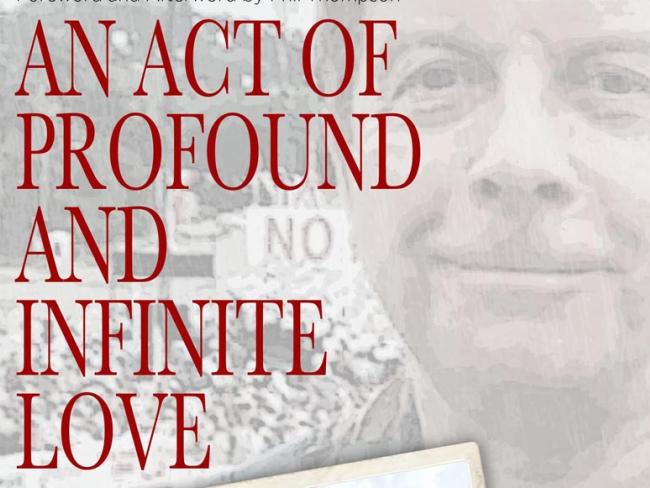
A new book takes you from Britain to many other countries, notably Cuba, where the author helped organise the supply of medical aid to the blockaded country…
An Act of Profound and Infinite Love, by Phil Lenton, foreword and afterword by Phil Thompson, paperback, 156 pages, ISBN 978-1916732735, i2i Publishing, 2025, £11.
Phil Lenton, a lifelong communist, a proud member of the CPBML and trade unionist, wrote this book before his death in 2017 at the age of 71, brought together by his comrade and friend Phil Thompson.
The book takes the reader with Phil from Britain to Germany, Cuba, Haiti and South America, to South Africa and Mozambique and to Syria and Palestine. In its pages we meet Nelson Mandela, Fidel Castro and John Hurt, as well as many British workers.
Phil intended to write to remember his father, Wal, a plumber, later a national officer in the GMB union. Taken prisoner at Anzio during the Second World War, he was held in a German slave labour camp. Wal organised his fellow prisoners of war to down tools at 5 o’clock in the afternoon, to the fury of the fascists.
Phil’s own eventful life then takes over the narration. He describes his involvement with Cuba, with Africa, and Palestine and Syria. He was probably the only British trade unionist who could say he had shaken the hands of two of the twentieth century’s leading revolutionaries, Fidel Castro and Nelson Mandela.
Cuba
Central to the book is Cuba. Phil’s involvement with Cuba began as a teenager, demonstrating in London during the Cuban missile crisis of 1962, under the slogan “US Hands Off Cuba”. Decades later, in 1994, he was sent by his trade union Unison to South Africa to assist with the country’s first democratic election. There he learnt of the role that Cubans had played in helping the Angolan people beat off attacks by the apartheid regime.
This led to his involvement in efforts to support Cuba against the US imperialist blockade. Phil was the leading force in establishing Salud International, a trade union campaign to break the blockade with ambulances, buses, medical equipment, food, even footballs, all on a grand scale.
The planning and organisational skills required to secure and assemble all these items from around Britain and Northern Ireland, to store them in readiness for loading onto ships, and to get them to the docks on time, must have been daunting. In total, Salud sent two and a half ships’ worth of vehicles and supplies to Cuba, on a scale never before attempted.
Leadership
There were doubters, of course, but with the same determination that workers had shown to support the NUM in the previous decade, Phil led them in overcoming every kind of obstacle, major or minor. Unison’s London Ambulance Service branch, known to the Cubans as the ambulanceros, played a central role in this and became much admired and honoured guests in Cuba.
The reader will learn more about Phil’s leading role in his trade union, both in the North East where he lived, and nationally. As a NUPE organiser he was central to organising workers to fight privatisation in the 1980s in health, local government, and the utilities gas and water, organising occupations not only of workplaces but of places like regional health authorities.
“The best kind of nationalist, an internationalist, and the best kind of internationalist, a lover of his own country…”
Three trade unions, NUPE, COHSE and NALGO, combined to form Unison in 1993. Phil worked hard at national level to build the new organisation. He brought together branches which, in some cases, were suspicious of each other and reluctant to merge, and sorted out the Byzantine financial details involved.
But this is more than an account of Phil’s work. There is much humour to be found in these pages, characteristic of his own wit and that of British workers.
For Phil, the same self-determination and sovereignty that the Cuban people asserted was just as important for the British working class. Opposed all his life to the EEC, later the EU, he threw himself into the campaign for a Leave vote in the 2016 referendum and lived to see the outcome.
He knew that our struggle to force the implementation of that democratic decision would be just as tough and protracted as Cuba’s fight against invasion and blockade. He was, as the book says, “the best kind of nationalist, an internationalist, and the best internationalist, a lover of his own country”.
The enigmatic title is a quotation from the Cuban trade union leader, Pedro Ross. In a speech to the TUC in 2004 he described socialism in Cuba in the striking phrase “an act of profound and infinite love”.
The book ends with a speech given at a memorial meeting for Phil in Newcastle in 2017, which concluded with Nikolai Ostrovsky’s words from the novel How the Steel Was Tempered. These words appear on many memorials, individual and collective, to Soviet workers who died in the fight to expel the Nazi invader from their lands, and subsequently on memorials to communists worldwide. They read:
“Man’s dearest possession is life. It is given to him but once, and he must live it so as to feel no torturing regrets for wasted years, never know the burning shame of a mean and petty past; so live that, dying, he might say: all my life, all my strength were given to the finest cause in all the world – the fight for the liberation of mankind.”
• An Act of Profound and Infinite Love is available to order online from the CPBML at https://www.cpbml.org.uk/shop.