
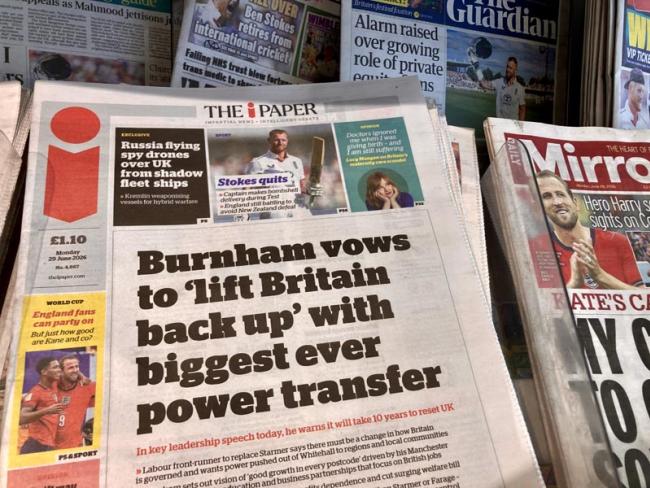
Ten years to “reset” the UK. More like 10 years of chaos and reaction. Photo Steve Travelguide/shutterstock.com.
From the start of his tenure as prime minister, Andy Burnham seems to be doing everything in his power to fragment Britain, just when unity is most needed…
The prime minister says he aims to “rewire the State” and create growth by devolving more power to regions. He also wants Britain to rejoin the EU. This is more of the same that we’ve seen over decades and is not what Britain needs.
Let’s look more closely at devolution, which Burnham is touting as his big new idea. But it’s not a new idea of course – in various guises, devolution has been government policy for decades.
In Scotland, 45 years of devolution demonstrably hasn’t worked. It breeds corruption and doesn’t improve people’s lives. It allows politicians to spend millions on diplomatic and economic links with the EU, and to use public money to promote separatism under the guise of “examining constitutional options”.
The founding myth of Scottish and Welsh nationalism is that Scotland and Wales were colonised by England. But this is not true: it ignores the reality of the creation of modern Britain and the struggle between economic classes that forged it.
Emerging
The emerging capitalist class in Scotland, Wales and England created the British state from the middle of the 16th century to the Acts of Union in 1707. The growth of capitalism brought about the growth of the working class, wage labourers.
At times used by the capitalist against the remains of the old order, workers were nevertheless ruthlessly exploited. Workers soon came to organise to protect their interests and then more widely as they recognised the usefulness of uniting and organising across the land.
Earlier on this was informal. Later on, workers explicitly acknowledged their strength in organising across Britain and saw the benefit of a united Britain to their class. Trade unions were united in the British Trades Union Congress in 1868.
The unity of Britain cannot be taken for granted. Nowadays, attacks go under the banner of nationalism. In September, officials of the Scottish National Party, Plaid Cymru and Sinn Fein pronounced that the United Kingdom and Britain must be dismantled.
They declared instead that the futures of Scotland, Ireland and Wales belong in the EU. With no apparent sense of irony, they say “their” nations have the right to self-determination. They do not even try to hide that their policy of devolution and secession goes hand in hand with subservience to the EU. But the EU is no friend of either the British or the Irish people. It should stay out of our affairs.
The Labour Party is no better: it pursues the same subservient policy. Andy Burnham opened the door to the separatist parties’ antics and their “new framework” when he completely misrepresented the 1998 Good Friday Agreement on a visit to Belfast in August.
Taking a high-handed leaf out of the EU’s book, he declared a referendum on uniting Ireland was off the table. But he has no power to unilaterally change an international treaty. As is becoming his habit, Burnham soon had to “clarify” his remarks, but the cat was already out of the bag.
Default
Successive governments have continually devolved powers to Scotland and Wales since 1979; it has become the default policy. This has taken many steps, sometimes legitimised with referendums, with voters generally hostile or indifferent.
Votes against devolution are seen as only temporary. Close votes or those marginally in favour are seen as an opportunity to push on.
The Blair Labour government enabled a devolved Scottish Parliament with considerable powers, laid the way for devolution in Wales, and in Greater London created the first directly elected mayor in the UK.
The consistency of Labour’s actions over decades suggests that their policy is to break up Britain. The Conservatives use different words, but in effect have done the same.
In response to the 2014 “no” vote against Scottish separation, the Cameron government gave yet more devolved powers to the Scottish parliament.
That government also oversaw significant steps towards devolution in England outside London. It made the 2014 Greater Manchester Combined Authority Deal, between the local councils and the then Chancellor: an elected mayor was imposed.
Less than a fortnight into his premiership, Burnham issued a paper on his plans for devolution called “Rewiring the State”. Many of the changes outlined were already the policy of the Keir Starmer government and some were already in law.
More for mayors
The English Devolution and Community Empowerment Act 2026 embeds a new layer of government (strategic authorities) and makes a shift towards mayoral rule in local authorities. The government forced the act through, against parliamentary opposition. It gives central government much more control over the structure of local government, with a window dressing of community empowerment.
But that was not enough for the former mayor of Greater Manchester. One of his new ideas is that devolved regions should be able to retain some of the income tax generated in their areas. There are many reasons to think that this might be a bad idea. So is the proposed “tourist tax”.
As well as leading to greater regional disparities (but remember, “growth in every postcode"!), the experience of devolved income tax in Scotland is hardly encouraging. The House of Lords was already enquiring into fiscal devolution. There are many pertinent questions – not least concerns about lessened accountability.
‘Talk of “localism” is no more than rhetoric. There is no intention to move power away from Westminster and closer to ordinary people…’
The proposal to align public services with the boundaries of strategical regional authorities will bring further changes. A wide range of local services will be included – most likely local transport, housing, innovation, local energy, cultural investment, education and employment, policing, fire and rescue.
And the creation of “deputy mayor roles with responsibility for key public services” strongly implies that responsibility for services affected will lie with the mayor’s office rather than with regional local authorities. This brigade of deputy mayors will be appointees of the mayors: neither elected nor civil servants.
The experience of mayoral government in London is that the mayor’s office increasingly overrides local decisions. For example, if a local authority in Greater London turns down a planning application for a residential development of more than 50 homes, it must notify the mayor’s office.
Very few applications are subsequently declined. Suspicions are that developers are squeezing more than 50 homes on to plots to get a hearing from the mayor’s office and sidestep local concerns.
Talk of “localism” is no more than rhetoric. There is no evident intention to move power away from Westminster and closer to ordinary people. Quite the opposite – another tier of government takes power away from communities and elected local councillors. Local councils will lose even more of their planning powers, and all their transport powers, to strategic authorities led by the mayor.
Many people are alarmed about these plans. A group called National Residents for Civic Accountability has been formed to fight for public accountability. It argues that “residents should be able to participate in civic life without being dismissed, marginalised, or excluded from decisions that shape their local environment.”
And some local authorities have launched or threatened judicial review proceedings against the plans, although this is likely to delay rather than halt them.
These are small and welcome steps, but a much wider challenge will be needed to roll back the fragmentation pursued by this government.