
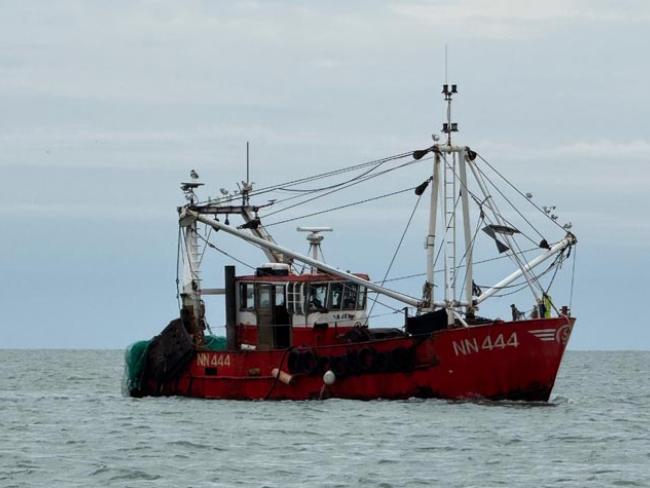
Trawler off Newhaven, East Sussex. Photo Workers.
The evolution of Britain’s fishing industry has witnessed many ups and downs. It is tied to the development of industry and the working class…
Britain is an island country with a wealth of coastal assets. Fishing here has a long history dating back to prehistoric times. By the sixteenth century, fishing was an extensive and important economic activity around the British coast and increasingly in distant waters.
But it was the industrial revolution which fundamentally transformed British fishing by changing the demand for fish and the ways it could be caught and transported.
Britain’s rapidly expanding industrial towns created enormous urban markets. The combination of railway expansion and improved preservation transformed fresh fish from an unaffordable luxury into an important source of protein and oils for workers.
Fishing reflected changes taking place throughout British industry. From the 1880s, steel-hulled steam trawlers increasingly displaced sailing vessels. They were as much a product of the industrial age as railway locomotives.
Larger vessels required more investment. Capitalist fishing companies replaced small family enterprises. Fishing became connected to banks and merchants.
Employers and skippers exercised considerable control over their workers who endured physically dangerous and demanding conditions. Most of our fishing ports have sad memories of vessels shipwrecked with loss of sailors’ lives.
At the same time, fishing communities developed distinctive forms of social organisation and trade unions emerged to defend workers’ interests.
By the beginning of the twentieth century, Britain possessed a huge, technologically advanced and capital-intensive fishing industry. It led the world in the scale and sophistication of its catching, processing and distribution.
Fishing was part of an industrial system. It benefited from world-leading manufacturing, finance and maritime trade and also contributed to them. Importantly, the development of fishing helped connect remote coastal communities to national markets.
During the First World War (1914-18) fishing vessels and fishermen became involved in naval operations with their invaluable knowledge of the sea and seamanship. And the fishing fleet helped feed the country.
This relationship continued during the Second World War (1939-45), not least the role of fishing trawlers in rescuing British and French soldiers at Dunkirk in 1940.
The end of the Second World War marked a decisive turning point for fishing. Changes in fish stocks, consumer habits, international competition and post-war economic restructuring all contributed to the industry’s long-term decline.
Britain’s wider industrial economy was also changing with the loss of heavy industry and the decline of coal and rail freight. The economic environment which had helped produce the nineteenth-century fishing boom was fast disappearing.
Sophisticated
What remained of the fishing industry nevertheless became more technologically sophisticated, allowing fleets to fish even further away and more intensively.
After 1945, countries increasingly asserted control over larger areas of surrounding waters. Britain extended its fisheries jurisdiction, while Iceland progressively expanded its exclusive fishing zones.
This led to the Cod Wars between Britain and Iceland in the 1970s. The disputes were about sovereignty, national economic interests and maritime power. Britain was no longer the dominant naval and industrial power. Iceland regarded control over its fisheries as vital to its economic future.
In 1973 Britain’s entry into the European Economic Community marked a major change. Our fisheries became subject to the Common Fisheries Policy. In 1973 Edward Heath’s government surrendered our 200-mile fishing limit.
Fishermen suffered a loss of control over local resources. The impact on the home fishing fleet was catastrophic. By the end of our EU membership, vessels from EU nations were taking at least half the total catch in British waters.
‘Fishing was a frontline issue in the 2016 EU Referendum…’
Despite economic decline over the last half century, fishing acquired symbolic importance. It became a powerful expression of a particular conception of Britishness, of us as an island, a maritime nation, and a country whose interests extended into the surrounding seas.
Fishing was a frontline issue in the 2016 EU Referendum. It was important to many coastal communities and also to our national identity and sovereignty.
Fishermen showed an extraordinarily high level of support for leaving the EU. Their hope was that Britain would take control of our Exclusive Economic Zone again.
But British governments and their negotiators refused to exercise control over our waters. Instead they betrayed our fishermen by allowing EU vessels to continue to operate in British waters. A further dreadful agreement in 2025 extended EU access to British fishing grounds until 2038.
The British fishing fleet has shrunk dramatically. By 2024, there were only 5,232 UK-registered fishing vessels, a 52 per cent reduction since 1994. And around 80 per cent of the remaining vessels are small, under ten metres long.
The British people cannot tolerate our fishing being on the road to eventual extinction. British fishing is linked to industry and independence – developing and declining together.
It will be a disgrace if British fishing disappears, to exist only in the realm of nostalgia, in museums or heritage centres.The attitude of the British people must change. They must press the government to withdraw from the unequal deals with EU and to restore national control over our waters.
Sharpen the dignity of our independence. Stop being bullied. Modernise our port infrastructure. Build more fishing boats again. Reintroduce training and apprenticeships to encourage young people into the industry. End the betrayal! Show we care for the future of fishing by enforcing positive change!
• A longer version of this article which looks back before the Industrial Revolution is available online at www.cpbml.org.uk.