
23 January 2026
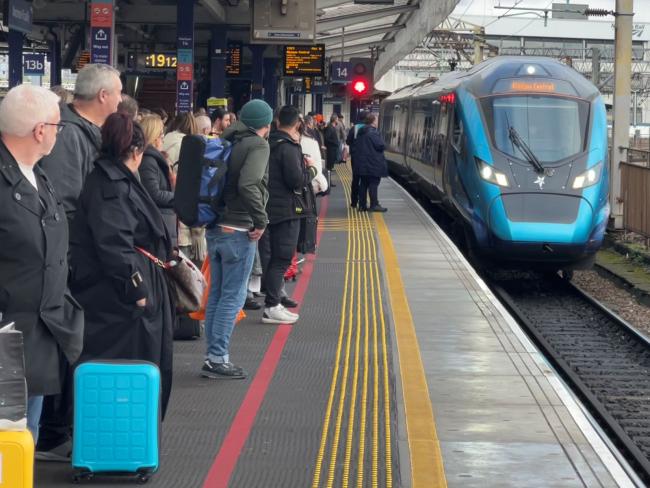
Rail provides a vital transport link. Passengers about to board a TransPennine Express train at Manchester Picadilly station. Photo Workers.
On 14 January Chancellor Rachel Reeves’ announced rail investment for the north of England. The headlines described a £45 billion plan. On closer examination it falls short of the action needed to improve rail in the region.
The people of the north of England – which has a population of over 15 million – are faced with increasingly unreliable and overcrowded trains with little prospect of meaningful rail improvements for decades.
Delayed
Northern Powerhouse Rail (NPR), as it is dubbed, was first announced in 2014. The strategic plan was for a series of inter-city connections that would fit with HS2. The plan took several years to take shape and was severely curtailed in 2021. Since then, decisions and action have been delayed several times – along with drastic cuts to HS2.
Reeves claimed that this time the plan will go ahead. But doubts persist – not only because of the history of the plan and the fate of HS2. The announcement lacks detail, firm timelines – and long-term funding.
‘This is seen as a failure to commit to the promised improvements.’
This is seen by many in the industry as a failure to commit to the promised improvements, and with claimed benefits already damaged by truncating HS2. Although money has been allocated for design work, there will be no construction work until the 2030s at the earliest. That has already raised questions from the construction industry.
Passengers will not begin to see improvements in services between Bradford, Leeds and Sheffield until at least a decade from now. Even then, those improvements are upgrades to the existing rail routes and not new lines.
Limited benefits
The announcement includes the construction of a new line between Liverpool and Manchester – but only once the improvements in Yorkshire are completed. That could be well into the 2040s. The third phase of this plan then involves upgrading existing trans-Pennine routes. And elsewhere, Hull and Newcastle would see limited benefits from all these plans.
The government has at least safeguarded the land for the extension of HS2 to Manchester from Birmingham. It says that it is still committed to building the line in some form – but that looks to be 20 years away, once NPR is completed. And it will probably not be the high speed railway that the Mayors of Manchester and Birmingham have called for.
Already full
Rail minister Peter Hendy was forced to concede that the West Coast Main Line north of Birmingham is already full, and that the extra capacity that this new railway would deliver is likely to be needed long before the 2040s.
Rail union RMT welcomed progress on the plan, pointing to the positive economic impact of investment in rail services. It called for work to begin as soon as possible.
Watching
And the National Audit Office will be watching. This Spring it will look at NPR, asking how the Department for Transport is setting up the programme for success. This will focus on progress since 2014, how the department plans to deal with key challenges and what lessons it has learned from other programmes, like HS2 no doubt.
One apparent victim of the updated NPR plan is the promised mass transit link between Leeds and Bradford. Plans announced last June with a fanfare from Reeves. It is now on hold and will be delayed after a review in December said the plan was too ambitious (to deliver by the mid-2030s!).
Now the West Yorkshire Combined Authority must take a more thorough approach to the link. That most likely means waiting on the NPR promise of a through line in Bradford linking its two central stations – an idea that has been around since 1845.