
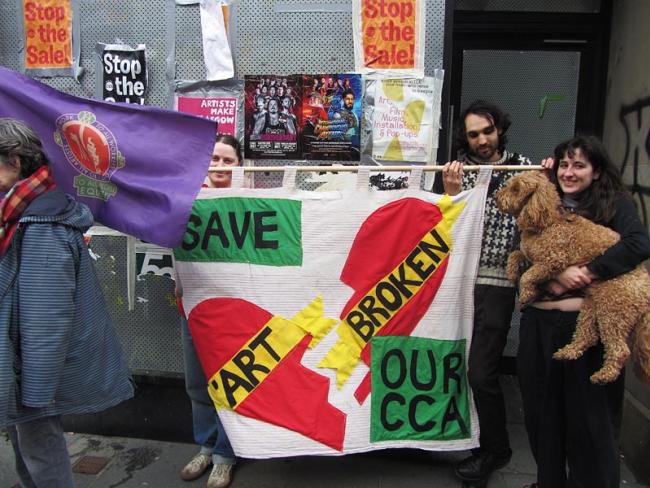
The protest at Glasgow’s closed Centre for Contemporary Arts on 20 September followed a 2 hour walk around the city highlighting the many art and music venues that have been shut down or sold off. Photo Workers.
Glasgow City Council – run by the Scottish National Party – was forced to reverse its money-saving policy of “fire and rehire” in October. It had previously tried to impose new contracts from January, which its workers opposed.
Over 23,000 workers – represented by the trade unions Unite, Unison and GMB – would have been sacked and rehired on contracts that lowered wages and worsened conditions. This practice will be unlawful under UK law from March 2027.
The tactic was being deployed by the City Council in advance of this ban. The SNP government in Edinburgh refused to act, saying it was a matter for local government.
In September, the City Council entered crisis mode as a budget gap of almost £110 million over the coming two years was confirmed. The reasons for the deficit include its obligations under the long fought for equal pay settlement of 2022 and dealing with the city’s homelessness crisis – made worse as the British government clears the backlog of asylum cases without fully supporting local authority costs.
The City Council then started selling off museums and venues, arousing the ire of those working in the cultural sector and their unions, such as Equity, the Musicians’ Union and BECTU. A protest movement has now developed with rallies highlighting the closed venues such as the Contemporary Arts Centre. This has gathered support from students from the nearby School of Art, whose famous Mackintosh Building still lies in ruins following two disastrous fires.